Rethink Your Software Manual for the Age of AI Agents
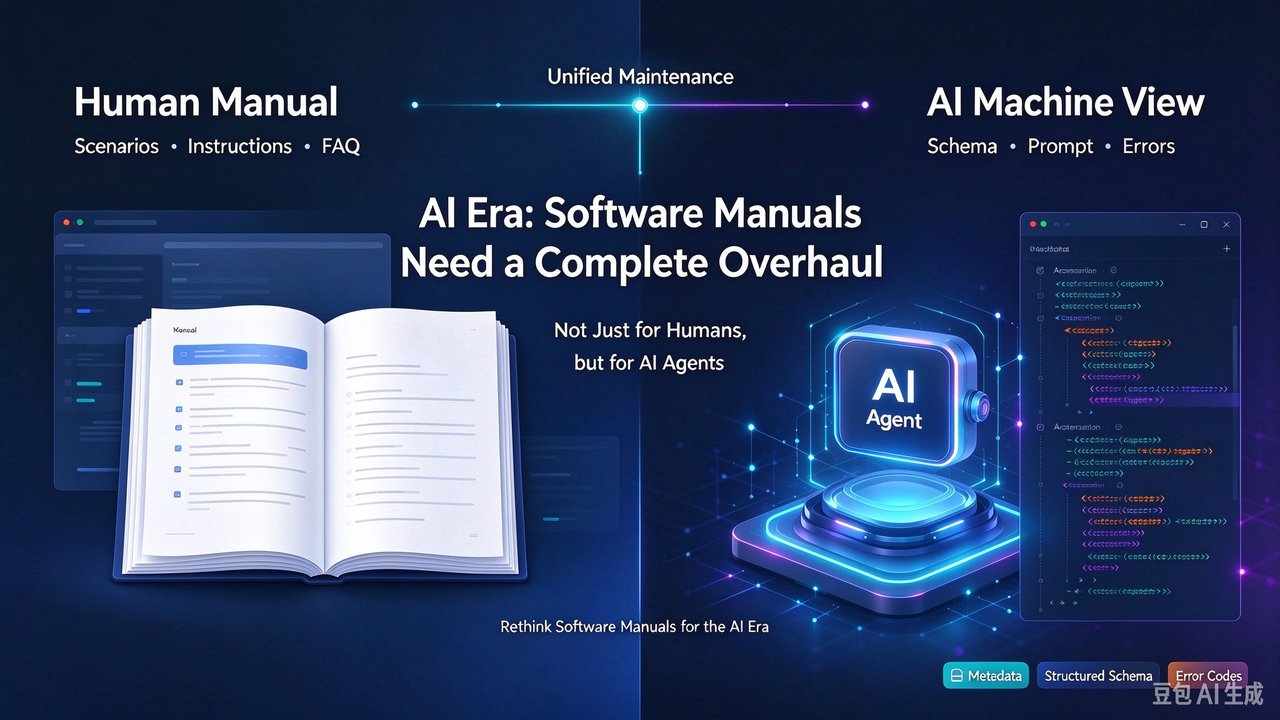
A manual is no longer just a booklet for people. It is machine infrastructure — something an AI system reads, parses, and calls tools through.
We keep talking about AI enablement, intelligent automation, and agent rollouts, while ignoring the most basic and most fatal problem underneath: 99% of today’s software tool manuals, product docs, and how-to guides are designed for humans only.
Traditional manuals are good at storytelling — scenarios, screenshots, explanations tuned to how humans learn. For AI agents, large-model tool calling, and automated workflows, the same documents are redundant, vague, unstructured, and hard to parse.
The result is a common industry pain point. Companies spend heavily to train AI and build agent workflows, and then — because the documentation does not support efficient AI reading — they get garbled calls, parameter hallucinations, failed executions, and endless retries. AI operating cost rises; automation success rate falls.
This article delivers a documentation restructure you can apply directly: why traditional manuals fail for AI, what the new dual-track human/machine architecture looks like, which six modules an AI-specific manual needs, and how to choose between the lightweight and enterprise rollout options. It does not cover model fine-tuning methods, and it is not a tutorial for any specific documentation tool — it answers one question only: how do you make tool documentation stable infrastructure for AI calls.
What you will get from this article
- The goal decides the content. A traditional manual exists to teach a human to use the tool; an AI manual exists to let a machine call it stably, cheaply, and with zero hallucination. Different goals require different content systems.
- An AI-specific manual has six modules, not just a prompt. Metadata, structured schema, a calling-constraint prompt, few-shot examples, error-code fault tolerance, and an AI-readable changelog — none is optional.
- Two rollout options. Small tools and fast validation use a single doc with dual zones; core business and enterprise systems use dual-document separation (
manual.md+tool-ai-spec.json).
Background: why traditional manuals do not fit AI at all
The common implementation mistake is feeding an existing product manual straight to a large model and expecting the AI to learn the tool by itself. What you get is readable but unusable — apparently functional and deeply unstable.
The fundamental difference is the goal:
| Dimension | Traditional human manual | AI-specific manual |
|---|---|---|
| Core goal | Teach a person to use the tool | Let a machine call it stably, cheaply, with zero hallucination |
| Content orientation | Scenarios, stories, screenshots, FAQ | Structured, standardised, strongly constrained, minimal information set |
| Optimisation metric | Learning experience, time to first success | Call success rate, token cost, response latency |
Four natural properties of human manuals run exactly counter to what AI calling needs:
- Redundant information, extremely high token cost. Product introductions, usage background, tips, and case stories help humans learn and are useless for tool invocation. Extra text keeps occupying the context window, raising inference cost and stretching latency.
- Vague language full of ambiguity and assumed common sense. “Fill in an appropriate amount”, “follow the procedure”, “exceptions apply” — humans resolve these from experience; the AI produces hallucinations and boundary-judgment errors, so calls fail.
- No structured definitions the machine can parse. Traditional manuals rarely specify parameter types, required fields, enum values, return structures, error codes, and rate limits. Without a standard structure, the model guesses calling rules from its generalisation ability, with extremely low error tolerance.
- Only “how to do it”, never “what you must not do.” Human manuals almost never mark capability boundaries, high-risk operations, forbidden behaviour, or parameter taboos — precisely the core constraints that prevent AI overreach and misuse.
Approach overview: a dual-track documentation system
You do not need to discard the traditional human manual. You build a dual-track architecture: one track for humans to learn and read, one track for AI machines to parse and call through — maintained from a single source, read independently, each doing its own job.
- Human view (kept as-is): serves users, ops, and operators; focused on scenario walkthroughs, step demos, screenshots, and FAQ troubleshooting.
- AI machine view (newly added): serves large models, AI agents, and automated workflows; focused on structure, standards, strong constraints, and a minimal information set that prioritises call efficiency and cost.
            single source
                  │
          ┌───────┴───────┐
          ▼               ▼
      Human view       AI machine view
      manual.md        tool-ai-spec
      ─────────        ──────────────
      scenarios/steps  metadata + Schema
      FAQ/troubleshoot constraint Prompt + error codes
      built to LEARN   built to CALL
Three design rules that hold up under iteration:
- Never let the two views contaminate each other — no stories in the AI view, no parameter tables in the human view.
- The prompt is one module of the AI view, not the whole thing. Pulling it out and optimising it separately does not fix missing schemas and missing error codes.
- Single-source maintenance, independent reading — both views update together when the documentation changes, so old and new rules never conflict.
The six core modules of an AI-specific manual
A complete AI-specific tool manual needs six core modules to remove all the uncertainty in AI calling.
1. Tool metadata (the basis for AI identification)
Header information the model reads first, so it can quickly recognise the tool’s positioning, cost, and status and avoid invalid calls:
- Unique tool identifier, version number, update time, deprecation flag
- Capability summary: one sentence on what the tool can do
- Capability boundary: what the tool cannot do (the core anti-hallucination field)
- Call cost, rate limits, maximum concurrency, timeout
2. Structured schema definition (the core of precise calling)
Replace vague prose with a machine-parseable standard structure, eliminating parameter guessing, benchmarked against the OpenAPI specification:
- Input parameters: name, data type, required/optional, enum constraints, format requirements, value range
- Return parameters: field definitions, data types, defaults, null rules
- Batch call limits: maximum row count, file size constraints
{
  "tool_id": "export-report",
  "version": "2.1.0",
  "cannot_do": ["does not export history older than 30 days"],
  "input": {
    "format": { "type": "enum", "values": ["csv", "xlsx"], "required": true },
    "rows":   { "type": "int", "min": 1, "max": 50000, "default": 1000 }
  },
  "errors": { "E429": "retry_after_60s", "E403": "abort_and_report" }
}
What this example demonstrates: parameter types, enum values, boundaries, and error codes are all declarative. The AI reads rules rather than prose it has to reason about — data-format correctness is guaranteed by the schema, not guessed by the model.
3. AI-specific calling-constraint prompt (the core of behaviour rules)
The schema solves data-format correctness; the dedicated prompt solves behavioural correctness. It defines every rule the AI follows when calling the tool, removing the need to re-train the model by hand. Four rule classes:
- Pre-call validation rules: non-empty parameter checks, enum matching, permission-check logic
- Forbidden behaviour rules: no over-limit batches, no privilege escalation, no custom parameters
- Failure handling rules: retry, abort, and escalation strategy per error code
- Output rules: result formatting, no fabricated information, concision requirements
4. Minimal few-shot examples (fast alignment on calling logic)
Drop the long human operation cases and keep only high-fidelity, minimal input–output pairs, aligning the model with standard calling logic on the fewest possible tokens and reducing interpretation drift.
5. Complete error codes and fault-tolerance strategy
A separate machine-readable error-code system that states the cause of each failure and the automated response for the AI, ending blind retries and stuck workflows after a failed call.
6. AI-readable changelog
Marks added parameters, deprecated fields, and rule changes so an AI agent can adapt to tool version iteration automatically, avoiding batch call failures caused by conflicting old and new rules.
Two rollout options, chosen by iteration cadence
| Option | Approach | Strengths | Trade-offs | Best for |
|---|---|---|---|---|
| Single doc, dual zone | Add a dedicated “AI reference block” inside the existing Markdown manual; humans read everything, AI reads only that block | Low transformation and maintenance cost; no document split | Limited structuring power; schemas for complex tools are less rigorous | Small tools, fast validation |
| Dual doc, separated | manual.md for humans; tool-ai-spec.json for AI carrying schema, prompt, error strategy, and examples |
Highest parsing efficiency, zero redundancy, strongest stability; plugs directly into agent frameworks and automated workflows | Higher initial transformation cost; needs a maintained specification process | Core business tools, enterprise systems |
Decision rule: validate value with the single-doc dual zone first, then upgrade to dual-document separation once the tool enters a core path.
Results and payoff: efficiency and cost-effectiveness
Many teams assume “documentation is a small thing; the model is the big thing.” In practice, the return from documentation standardisation is far higher than what small-scale model fine-tuning delivers (based on the deployments we have observed; results vary by team and tool complexity). Restructuring the AI-specific manual solves three core problems directly:
- Much lower AI operating cost — lean, machine-readable documentation strips useless redundancy, reducing context token consumption, inference cost, and response latency, with excellent long-run cost-effectiveness.
- Far fewer hallucinations and failed calls — structured schema plus strong-constraint prompt plus explicit boundaries restricts AI freedom at the source, eliminating parameter invention, privilege escalation, and logic errors, turning tool calling from guessing into determinism.
- A maintainable, iterable AI workflow — when the tool versions, the AI specification versions with it. No repeated fine-tuning, no prompt rewrites; agent capability upgrades smoothly alongside the tool.
The opposing view and the applicability boundary: teams that argue “optimise the model first, documentation later” may hold a defensible position in the short term while model capability keeps rising. But as long as tools keep iterating and agents keep calling them in bulk, the failure and retry cost of unstructured documentation keeps accumulating. That is exactly why both rollout options keep a “trade-offs” column: the lightweight option is less structurally rigorous, the enterprise option costs more up front. Take it stage by stage — there is no free, one-shot solution.
Conclusion
- Different goals require split content — documentation shifts from empowering people to empowering AI automation, so the human view and the AI machine view must run in parallel.
- All six modules are mandatory — metadata, schema, constraint prompt, few-shot, error codes, changelog; the prompt is only one of them.
- Pick the rollout cadence first — lightweight work starts with a single doc and dual zones; enterprise systems go to dual-document separation. Validate value before raising the standard.
In the early phase of AI transformation, what separates teams is rarely model selection or algorithm strength — it is standardised, machine-readable base infrastructure. Completing the AI-specific manual restructure early builds the most solid, most cost-effective foundation for AI agent rollouts. Start with your single most critical tool and write its “AI reference block.”
Related reading on this site: more AI agent engineering notes in the knowledge base. External references worth reading: the OpenAPI Specification.
Did your team hit a documentation problem while wiring an agent to a real tool? Open an issue or leave a comment — I reply to every one.