Human Out of the Loop: A Concept Contract for AI Delivery Organizations
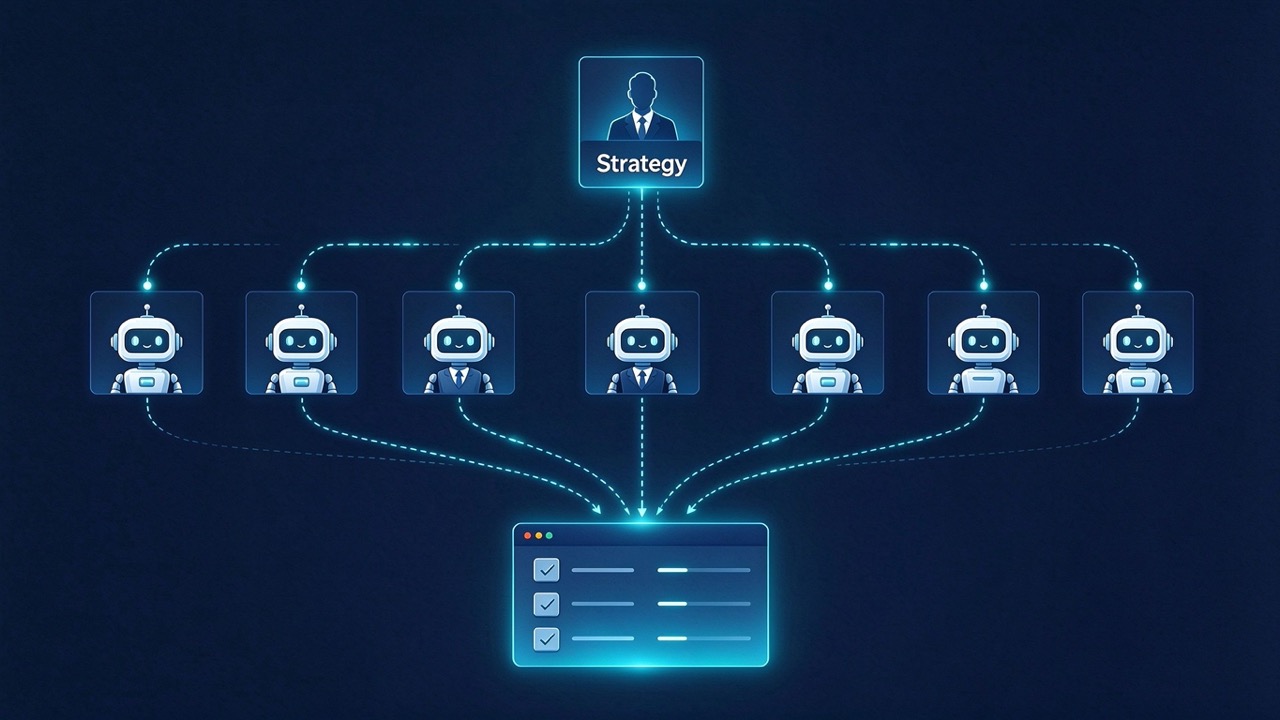
Series: Idea-to-Production · the concept instalment
It is not a chatbot, not a code generator, and not a pipeline someone watches. It is a delivery organization — org chart, runbook, and audit trail all living in git. This piece defines, with contract-grade precision, exactly what “human out of the loop” claims and what it forbids.
Every discussion about AI agents eventually collapses into the same vague question: “how much of this can we automate?” And the answers are all feelings — “mostly automated”, “we keep a human at the critical points”. This piece does the opposite: write the automation as a contract precise enough to check claim by claim, then use it to audit every segment of your own system and see where your “automation” is deceiving itself.
There is no code here — only the concept, the mechanism family the concept forces into existence, and the methodology that keeps the whole thing from rotting. The two interface screenshots exist only to show what the concept looks like once it lands in a running system.
Why this is worth your time
Feelings cannot be audited. “Mostly automated” is neither falsifiable nor checkable; two sides each hold a percentage, and the project oscillates between “fully automatic” and “afraid to let go”. Once automation is rewritten as explicit claims, each one can be tested individually: it passed, or it did not. The contract doubles as an audit ruler — walk your workflow segment by segment against it, and whichever segment still depends on a human replying has not yet been cashed in.
Three takeaways
- Autonomy must be defined by claims, not percentages. “No manual approval gates” is testable; “mostly automated” is not. Write your loop as explicit claims first, then audit it segment by segment.
- Every human gate you delete must be replaced by a machine gate. Review checkpoints, integration-surface review gates, and end-to-end tests are not optional — they are the price tag of this contract.
- The human role moves up a level, not down in frequency. Not “review fewer times” — a permanent move from in-loop, per-task approval to out-of-loop improvement of the system itself.
The contract: four claims
“A human provides an idea, the system delivers it to production” sounds like a slogan. Only when it is decomposed into claims that can be falsified does it acquire engineering meaning. Our four:
| Claim | Statement | What it forces you to build |
|---|---|---|
| One action starts everything | A human only creates the project (or writes one initial idea); from then on, every task is written, dispatched, claimed, executed, and reviewed by agents | A dispatch role that can write tasks, not merely do them |
| No approval gates | Nowhere in the loop: no PRD sign-off, no release go/no-go, no manual rollback decisions | Machine quality gates that genuinely stop bad output |
| Never block on humans | Human notification channels are escalation paths only — record and notify, then continue along a documented branch or stop cleanly; they never wait for a reply and never equal approval | A written continue/stop branch at every escalation point |
| Humans above the system, not inside it | The human’s standing job is meta-review: read governance reports, improve agents, skills, workflows, and knowledge | Self-reporting loops: audit trails, health reports, efficiency signals |
Claims two and three are where the vast majority of “autonomous” agent systems quietly fail. Cut them and you have a demo; honor them and you are forced to solve the real problems.
What it is not
Three misreadings kill the concept on contact, so they are written down as explicit exclusions:
- Not a chatbot. The center of the system is not conversation — it is a task board with dependencies, locks, and an append-only audit log.
- Not a code generator. Code is just one artifact among many: requirements, architecture, UI design, test strategy, plans, release notes, reports. The genuinely interesting engineering is in the handoffs, not in the typing.
- Not a watched pipeline. Supervising at a fixed station (every PR, every release) is still a human sitting in the loop. Here, humans see reports, never requests.
One-sentence portrait: an autonomous delivery organization — the same furniture as a human company (roles, runbooks, escalation paths, audits), except every chair is occupied by an agent, and no chair is reserved for you.
Why accept such an extreme contract?
Because the constraint is a “forcer”: the three things it forces out are exactly what you have always wanted and what semi-automated systems never deliver.
Price one: nobody signs off, so quality is either machine-executable or nonexistent. Every sentence of the form “a senior engineer would notice at a glance” must become a written specification: per-deliverable review checkpoints (no recorded review PASS, the task is not Done), an integration-surface review gate between implementation and tests (a BLOCK verdict halts the transition outright), and end-to-end tests run against the real UI. Weak gates plus autonomy = errors amplified at machine speed; the contract elevates gate design into a core engineering topic.
Price two: nobody comes to unblock you, so failure must have deterministic semantics. A stuck task must not become “waiting for a human” — that is a lie. Instead: diagnose, a bounded number of retries, then escalate by opening a new task (agent to agent), or record the notification and stop cleanly along a documented branch. Failure handling becomes part of the workflow definition, never improvisation.
Price three: nobody watches the pipeline, so observability is a design input, not an after-the-fact patch. Every claim, release, expiry, and job run lands in the append-only audit log; every resident loop emits its own health and governance reports. The system must remain answerable long after the unattended moment has passed.
The three cornerstones of the concept
Three ideas hold up the whole architecture, each getting its own deep dive elsewhere in this series:
1. A three-layer separation, split by rate of change. Knowledge (how each role works), scheduling (who does which task, when), and archives (what was produced). Mixing layers is the root disease that stops most agent frameworks from evolving: you certainly do not want to redeploy the scheduler just to teach one agent a better checklist. → See the instalment Why Split into Three Repositories: The Separation Rule of Knowledge, Scheduling, and Archives.
2. A fixed nine-role org chart. Product and project management, engineering architecture, full-stack engineering, UI/UX and copy, QA and release, service and data operations, marketing and growth, administration and finance — plus a platform-side watchdog sentinel. One vocabulary, two spellings: a role’s content folder and its runtime ID map strictly 1:1, and drift is never allowed. → See the instalment How Nine Roles Share One Company: an Agent Org Chart That Never Drifts.
3. Work flows along named document artifacts. Idea → requirements → solution → design → plan → code and tests → E2E → release → report: thirteen stages, each consuming one artifact and producing one. These artifacts are the APIs between agents — typed, inspectable, and, as the instalment Documents as Executable Assets argues, executable in the strictest sense. → See the instalment The Thirteen Stages and Their Artifacts: the Type System Between Agents.
What the contract looks like in a running system
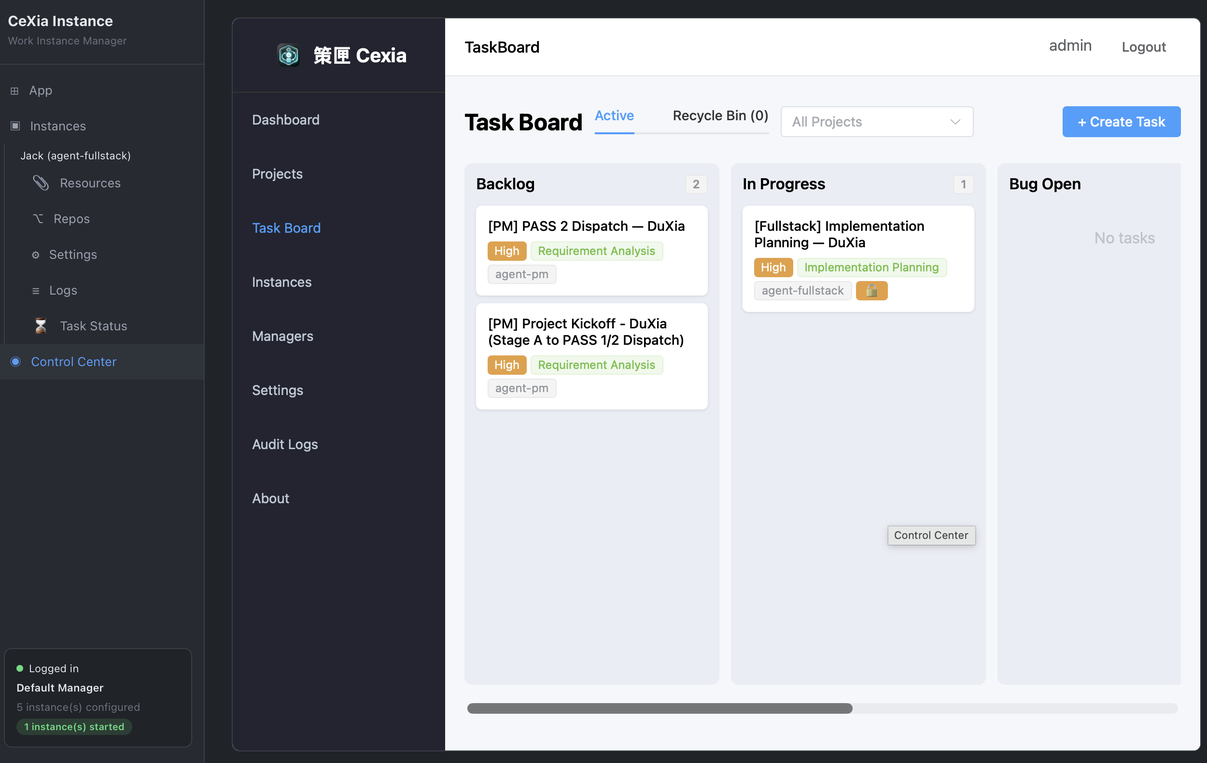
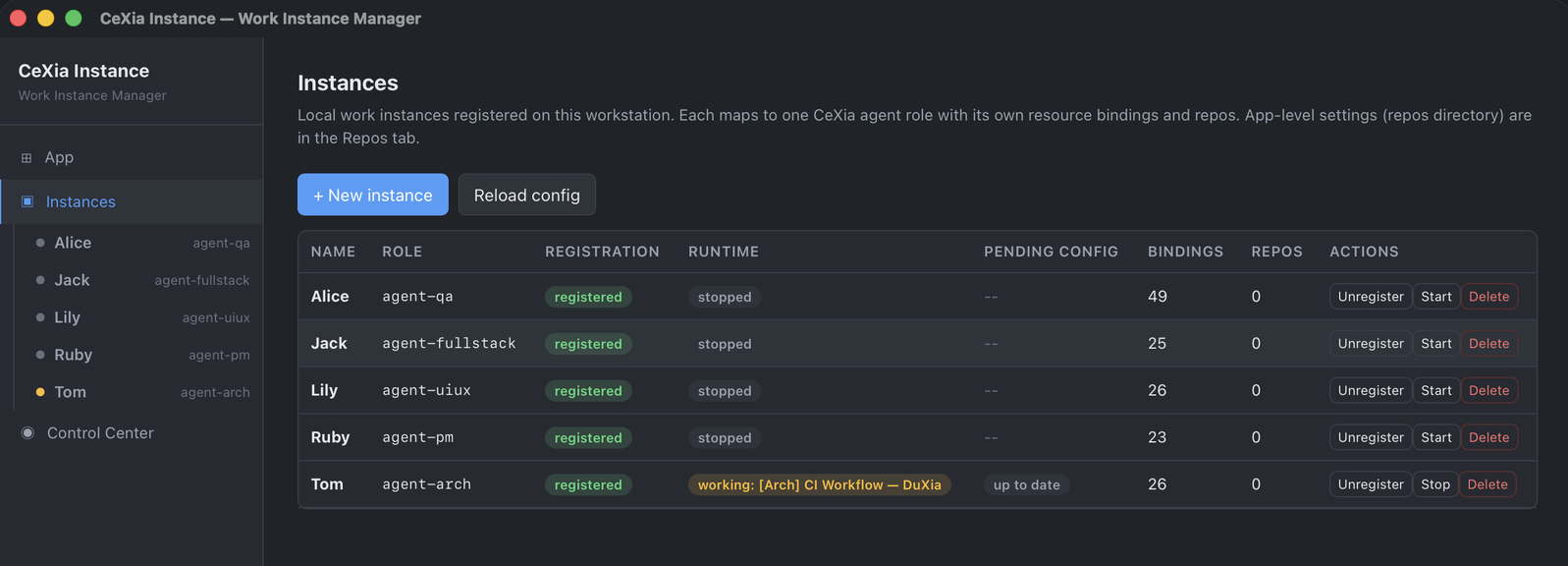
Two screenshots answer exactly one question: “what does this contract look like from the outside”.
“A human writes one task, the board fills itself” — literally: after one “idea to requirements” task is created, the design, implementation, QA, and release cards are dispatched by agents, each carrying its role and its dependencies:
At the operations level, the “nine roles” become nine kinds of work instance: one role can run several instances at once, spread across multiple machines, and each instance binds that role’s agent, skills, workflow, and knowledge:
The machine details that guarantee “one task, one worker” and “no self-scheduling” — atomic claim locks, centrally pushed jobs, lease-expiry reclamation — belong to the mechanism layer and get their own piece → see Three Mechanisms of Unattended Scheduling: Claim Locks, Central Push, and Idempotency Keys.
Methodology guardrails: five taboos
The concept starts to rot the instant you grant it its first exception. Five invariants we treat as non-negotiable (breaking any one is a framework defect, not a local bug):
| Taboo | Which face of the concept it guards |
|---|---|
| Don’t add a human approval gate “for insurance” | It quietly turns the system back into a watched pipeline — the contract itself is the product |
| Don’t let agents schedule themselves or renew their own next run | Roles may be multi-instance; self-scheduling guarantees duplicate work; periodic ownership lives in the center |
| Don’t start work before winning the atomic claim | Two instances on one task = duplicate output plus write conflicts |
| Don’t leave TODOs or placeholders in delivered documents | Downstream agents execute documents verbatim — your TODO becomes their instruction |
| Don’t write the same principle into a second document | Two copies always fork; to reference, link the source of truth |
Notice that four of the five concern documents and scheduling, not models or prompts. That is the honest portrait of an autonomous agent organization: applying distributed-systems discipline to paperwork.
Scope guard
This piece defines only the concept. Deliberately excluded: lock protocols and API details, release pipelines and cloud topology (the mechanism layer, covered by the mechanism instalments of this series), model selection and cost (outside the series), and the question of “whether your team should delete all its gates” — this is one system’s contract. What transfers is the discipline of writing the contract down, not our specific terms.
Conclusion
- “Human out of the loop” is a contract, not a confidence level — four falsifiable claims (one action starts everything; no approval gates; never block on humans; humans above the system), each forcing specific mechanisms into existence.
- Accepting the extreme constraint pays for itself, because it buys exactly the three things semi-automated systems never give you: machine-executable quality, deterministic failure semantics, and built-in observability.
- Start with this piece, on your own project: write the autonomy contract of your loop as claims, then walk the workflow once and honestly mark which segment is currently waiting on a human reply — that segment is your first real engineering task.
This is the concept instalment of the Idea-to-Production series; lock protocols, scheduling mechanisms, and release topology are covered in the mechanism instalments. If you are building your own agent organization, you are welcome to start by writing down your four claims and bringing the audit result back to the comments.