The Free-Model Privacy Trap: Keep Sensitive Data Out of Free AI Coding Clients
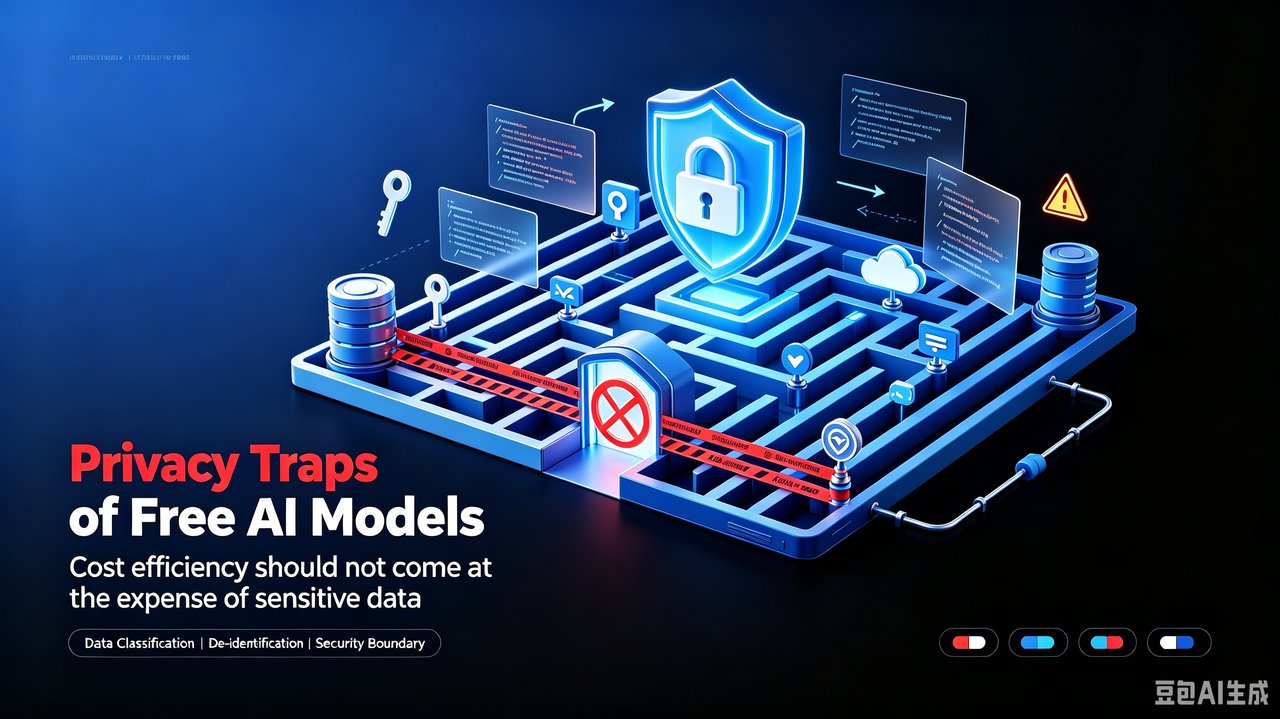
A “free” AI coding client is rarely free. The price is often paid in data. The tool you use to write code, run agents, and process business data — OpenCode, WorkBuddy, TRAE Code, Cursor, or any free-model API — can see not just the snippet you paste but your entire codebase and context. High cost-effectiveness must not come at the price of sensitive data.
Why it matters
Big-name vendors usually de-identify and anonymize inputs before any training or analysis, and they publish a privacy policy with compliance controls such as an opt-out for “don’t train on my data.” Their risk is controllable because the policy is transparent.
Unknown free-tier or no-policy AI coding clients are different. They frequently have no transparent policy at all. The “free” price tag may exist precisely because the vendor monetizes your input — harvesting it for training, building profiles, or directly scraping sensitive information. You think you’re saving cost; you’re selling your assets.
The point is not whether one specific vendor is safe. Any unknown or free-tier AI client deserves the same privacy red line.
The most dangerous, innocent-looking actions
Small teams, trying to cut cost, casually add these “free AI tools” into daily dev flow:
- Pasting a config file that contains secrets into an unknown AI coding client (agent).
- Throwing a customer list, a contract, or medical records at a free model to parse.
- Running a production database export through an unverified third-party plugin.
The tool sees not just what you paste, but your whole codebase and context. So the danger is about AI agent clients and free models used in coding and dev work — not about pasting into a chatbot.
These are coding clients, not chat boxes
The tools here are what you use to write code, run agents, and process business data: OpenCode, WorkBuddy, TRAE Code, Cursor, or any free-model API. The point is not whether one vendor is safe; ANY unknown/free-tier AI client deserves the same privacy red line.
Data tiering: pick the tool by where the data goes
The selection core is not “expensive vs. free” but “where does the data go.”
| Data type | Where it should go | Why |
|---|---|---|
| Public docs / learning examples | Any free tool | No sensitive information |
| Internal business code (no secrets) | Named-vendor free tier, confirm de-id policy | Big vendors de-identify; risk controlled |
| Config with secrets / credentials | Never into any cloud tool | One leak is a disaster |
| Customer / personal sensitive info | Only trusted enterprise env or local model | Compliance red line, non-negotiable |
Three landing disciplines
- Vet the vendor. Is it a known company? Privacy policy? Can you opt out of training on your data? If not, treat as highest risk.
- Desensitize before paste. Strip keys, names, and customer IDs into placeholders before anything sensitive reaches the tool.
- Tier-based usage. Public code goes to the free tier; secret slices go only to trusted or local environments. Solidify a hard rule into
AI-CONTEXT.md.
Hands-on: let secrets never reach the model
Tiering decides whether to paste, but when the AI must touch a project containing secrets, you need a mechanism so secrets never enter the model’s view.
Read secrets at runtime from keychain / environment variables
Secrets are injected locally at runtime only; the code holds variable names, not plaintext. The AI only ever sees os.getenv("DB_PASSWORD") — never the real value.
# ✅ model only sees the variable reference, never the real secret
import os
db_password = os.getenv("DB_PASSWORD")  # value from keychain/env, injected at local runtime

# ❌ never write this into code/config the AI will read
db_password = "sk-1a2b3c4d..."  # plaintext secret in context = immediate leak
Shrink the AI workspace scope
Put only the task-needed folders into the agent context. Don’t hand the whole repo or disk to the model. Smaller scope means a lower chance of dragging in secrets or sensitive files by accident.
.gitignore is NOT enough
.gitignore only blocks pushing to the git cloud. The AI scans the local working tree to run tasks, so ignored files still get read by the model. Secrets must exist only in the keychain / environment and at runtime — nowhere in the local filesystem.
Fewer relay platforms is a safety net
Desensitization and isolation rely on humans remembering to do them; mistakes are hard to fully avoid. Fewer unknown free-model layers means fewer exits where a slip amplifies into a leak. Treat “fewer dependencies” as the last line of defense — defense in depth, not optional polish.
One-line principle
Secrets never get exposed to the model. Any step requiring “pasting the secret to the AI to run” means the process itself must change.
Tradeoffs and honest limitations
Keeping secrets out of the model adds friction. Runtime secret injection and a shrunk workspace mean you can’t just point the agent at the whole repo and say “fix everything.” Local models or trusted enterprise environments solve the privacy side but cost more or need infrastructure — which is exactly the cost-effectiveness tension this article is about.
The goal isn’t to reject free tools. It’s to make the price explicit and pay it deliberately, rather than accidentally, with a data breach. Data tiering turns a daily gamble into a quick table lookup.
Summary
- A “free” tool’s hidden cost may be your data — treat unknown tools as the highest risk.
- The core is not expensive vs. free, but where the data goes; secrets and personal info never enter the cloud, and you desensitize before submitting.
- Solidify the tiering rules into
AI-CONTEXT.mdso every session enforces them — save cost without owning the security bill.
Before pasting anything sensitive, run it through the tiering table. Ten seconds of desensitization can save an unrecoverable leak.