Multi-Model Collaboration: The Art of Assigning AI Models by Task Complexity
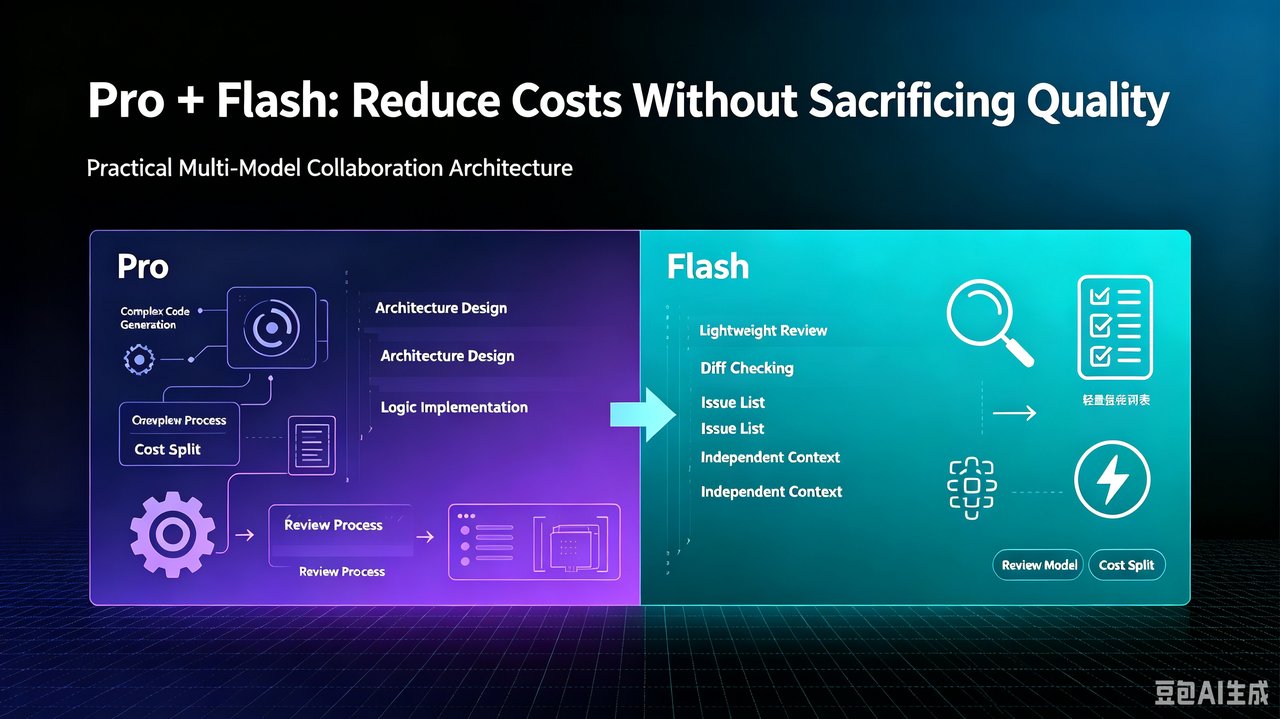
Every engineering team using AI faces the same dilemma: Pro models are expensive, but Flash models lack quality assurance. What if you could have both?
The answer lies in a simple principle: assign models by task complexity, not by role.
The Core Principle
Not all tasks are created equal. Planning and architecture decisions require deep reasoning — that’s where Pro models shine. But coding, testing, and formatting are mechanical tasks that Flash models handle just as well.
The key insight: review models must NOT share context with coding models. They need to judge the code independently, like a real code review.
Two Proven Approaches
Dual-Model (Minimal Viable)
The simplest approach: use Pro for coding and Flash for review.
| Role | Model | Responsibility | Cost |
|---|---|---|---|
| Coding | DeepSeek V4 Pro | Core implementation | Billing |
| Review | DeepSeek V4 Flash | Independent CR, vulnerability check, logic review | ~1.56 credits/review |
This works because review is a high-frequency but low-cost-per-call action. Flash handles it well at a fraction of the cost.
Triple-Model (Advanced)
For larger projects, add a third model for even better results:
| Role | Model | Responsibility | Cost |
|---|---|---|---|
| Planning | DeepSeek V4 Pro | Requirements, architecture, task breakdown | High (single call) |
| Execution | DeepSeek V4 Flash | Implement code per plan | Low (multiple calls) |
| Review | GLM-5.3-Flash | Independent review, cross-model blind spots | Low |
The triple-model approach adds cross-vendor blind spot elimination. When your review model comes from a completely different family (GLM vs DeepSeek), it catches issues that same-vendor review would miss.
Real Production Data
I ran this in production for 7 days. Here’s what I found:
- Flash code review: 32 tool uses, 92.74 seconds, 1.56 credits
- Cost breakdown: Pro (coding) = 0 credits, Flash (review) = 1.04 credits
- Result: 80% cost reduction on code review
The numbers speak for themselves. Multi-model collaboration isn’t just a theoretical concept — it’s a practical, proven approach to cost optimization.
Key Design Rules
- Review model must NOT share context with coding model — independent judgment only
- Use different model families for review to avoid blind spots
- Return execution summary (calls/time/credits) + issue checklist
- Start small — try dual-model on your smallest task first
Getting Started
Start with the dual-model approach on your smallest task. Once validated, consider upgrading to triple-model for cross-vendor blind spot elimination.
The principle is simple: use the right model for the right task. Don’t overpay for complexity you don’t need.
Multi-model collaboration is the future of cost-effective AI development. The question isn’t whether to adopt it — it’s how quickly you can start.