Docs as Executable Assets: Writing Specifications Agents Can Run Verbatim
Series: Idea-to-Production · Practice. Companion pieces in this series: Human Out of the Loop: A Conceptual Contract for an AI-Native Delivery Organization and Thirteen Stages and Their Artifacts.
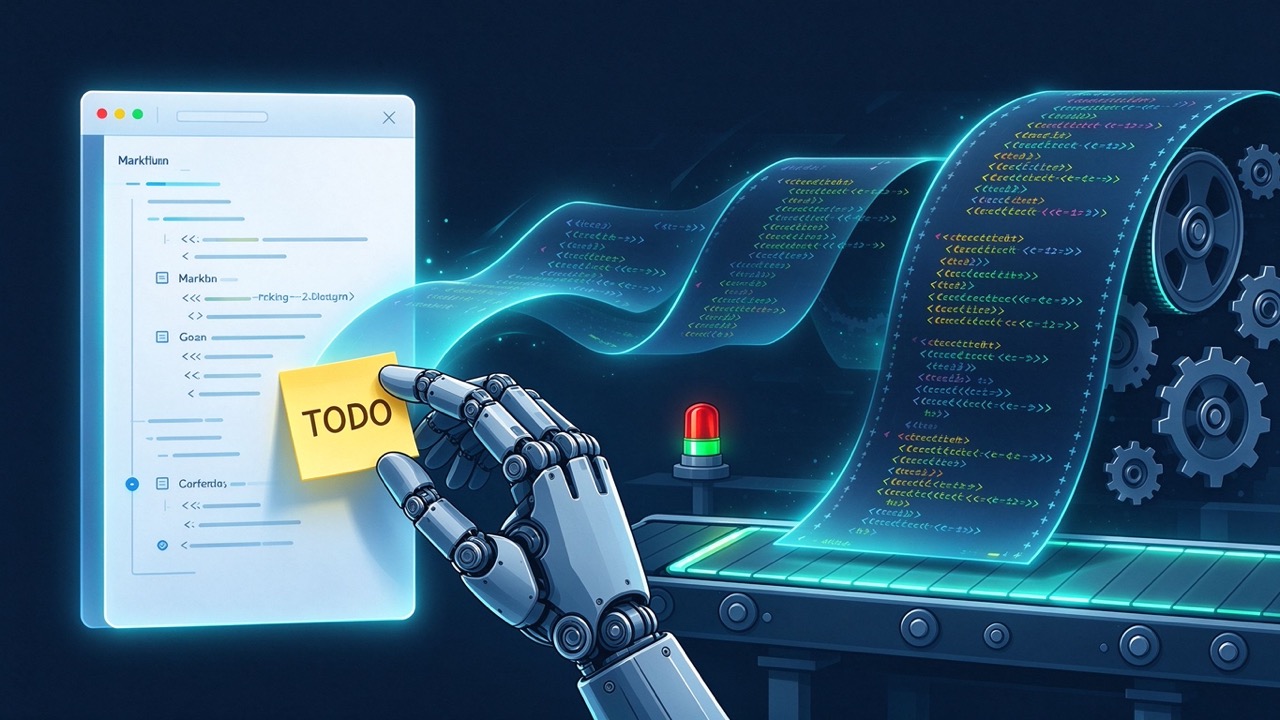
Human documentation has always relied on an invisible error-correction layer: the reader. A colleague fills gaps with team conventions, routes around a TODO, and ignores a stale paragraph. Agents have no such buffer. In a delivery system where AI agents hand work to each other, this is the most underestimated layer of engineering: however strong the model is, the quality ceiling of your system equals the unambiguity of your handoff documents.
This article is about accepting one setting we were forced into — documentation is an executable asset: it has typed interfaces, it can hide bugs, and real agents run it 24/7 in production — and the five writing disciplines that follow from it. These are not prompt tricks; they are the upstream craft of making “writing docs” itself an engineering activity. Every discipline below came out of a real postmortem.
What you will take away
- Review every delivered doc like a public API. Its input assumptions, output contract, and term definitions deserve the same scrutiny as a function signature.
- A TODO in a delivered doc is runnable dead code. Humans route around placeholders; agents execute them.
- Copying is forking. The moment a principle is written into a second document, you own two truths that will drift apart on their own.
How a document gets “run”: two paths
In this system a document is not reference material. It has two real execution paths.
Path 1: the artifact chain
Stages hand work to each other through named documents — requirement.md, solution.md, tech_design.md, plan.md — and the downstream agent deep-reads each one and produces its output from it. An architecture document with any ambiguity gets implemented literally by the next stage.
Path 2: runtime assembly
When a work instance takes a task, it assembles the knowledge-layer resources into one structured context prompt and hands it to the AI CLI — a fixed eight-segment shape, order never changing:
1 General rules   2 Project context   3 Role rules   4 Workflow
5 Knowledge resources   6 Available tools   7 Skills   8 Task definition
Of the eight segments, only task definition is always present; general rules, once bound, never disappear — an empty segment renders rather than silently vanishing; the remaining segments appear or are omitted depending on the resources bound to the instance. In other words: every word you write in the knowledge layer enters the model’s context in that exact textual form and is executed as an operating instruction. From this point on, writing documentation is not support work — it is programming work.
Five doc bug classes, each paired with one discipline
1. Ambiguous spec → hallucinated subsystem
“Add basic auth.” A human teammate assumes the team’s conventions; an agent hands back a freestyle login universe. Most so-called “agent hallucination” actually happens at this moment: the model merely executed your ambiguity.
→ Discipline: doc-first. The spec changes before the implementation that fulfills it; writing to the precision where “the next role doesn’t need to ask” is the minimum bar for a stage handoff. When doc and code disagree, it enters the bug queue — it is not shelved as chores.
2. Placeholder → runnable dead code
Drafts leave unclear parts as TODOs. In a human world, the note lies quietly; in an agent’s world, the downstream stage implements “TODO: add rate limiting” as a requirement — or, worse, produces “none” from the empty part. Humans route around placeholders; agents execute them.
→ Discipline: zero placeholders in delivered docs. A part that isn’t thought through should not enter delivery; send one fewer doc rather than one with holes in it.
3. Restated principles → two diverging truths
Copying the same rule into a second document “for readability” is where everything starts. Three months later, each copy has been edited a round on its own, two agents quote one copy each, behavior splits — and nothing errors anywhere.
→ Discipline: single source of truth, link instead of copying. A principle is defined in exactly one place; other locations may only carry a link to it. This discipline is cheap to keep and expensive to break.
4. Terminology drift → silent routing failure
Role IDs, stage letters, and task-type vocabulary each have one spelling in the content layer and another in the runtime. Fixing place A and forgetting place B produces a symptom of “that class of tasks mysteriously never gets picked up again” — no exception, only backlog.
→ Discipline: naming is fixed once; renames are cross-repo sweeps. Treat namespaces as a public API (see How Nine Roles Share a Company: An Agent Org Chart That Won’t Drift).
5. Missing docs → degraded execution
The process requires a workflow file per stage. Without it, the agent “improvises”: it substitutes generic knowledge for project conventions — every time, and differently every time. That is how variance enters the pipeline.
→ Discipline: the execution surface needs doc backing — one one-page work instruction per stage, loaded on demand. Thirteen precise one-pagers beat one tome nobody finishes.
Self-check
Pull out the critical handoff documents in your repository and ask, one by one:
- Are its input assumptions written down (which upstream files it depends on, what happens when they are missing)?
- Is its “definition of done” decidable, or is it phrased like “well designed” — something only a human can smooth over?
- Search the whole file for TODO / TBD / placeholders — are any inside the deliverable?
- Do the principles cited here have a second “translated version” anywhere else?
- Are the terms spelled identically across both systems, guarded by a mapping table?
If you cannot answer any one of the five, that document is running in production with an unfixed bug.
Conclusion
- “Docs are executable” is not a metaphor: they are either implemented literally in the artifact chain or injected as-is into the eight-segment context. Your docs are already running — the only difference is whether a human or an agent runs them.
- The five disciplines share one essence: bring software engineering into writing — interfaces must be defined, placeholders may not ship, there is only one truth, naming is managed as an API, and execution must be doc-backed.
- Start from the smallest action: pick your most important handoff doc, fix it once against the self-check list, then observe whether the variance in the next run shrinks — the cheapest, fastest-feedback experiment in this series.
Further reading in this series: Human Out of the Loop: A Conceptual Contract for an AI-Native Delivery Organization, Thirteen Stages and Their Artifacts, and How Nine Roles Share a Company: An Agent Org Chart That Won’t Drift.