6 Core AI Engineering Capabilities: Cost Awareness, Rule Systems, and Continuous Optimization
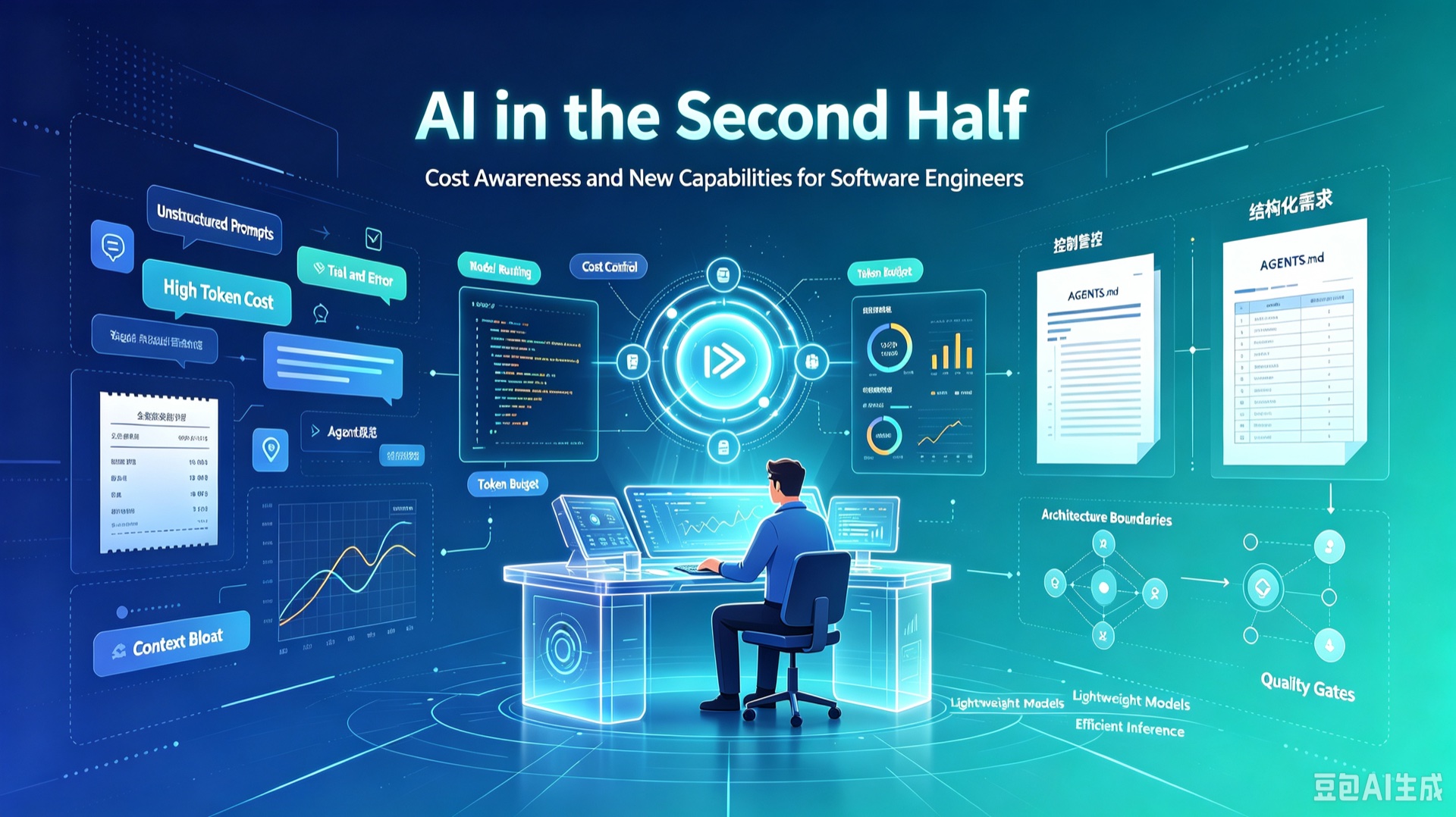
In early 2025, I burned through $87 in API credits in a single weekend. The code those credits produced? About 40% of it got rewritten within the week.
That’s when it hit me: AI isn’t a free lunch anymore. We’ve crossed an invisible line — from the “free trial era” of generative AI into the Cost Awareness Era. And most engineers aren’t ready for it.
This article presents a practical 6-capability framework for moving from AI consumer to AI commander — someone who doesn’t just use AI, but governs it with discipline, rules, and measurable outcomes.
1. The Wake-Up Call: Three Signals
Three signals make the cost shift impossible to ignore:
1.1 Personal Costs Are Real
Between Cursor subscriptions, API calls, and the growing stack of AI-enabled tools, many developers spend $40–100+ per month on AI. Every thoughtless retry, every “just throw more context at it” impulse — it all has a line item now. Token consumption has become a personal operating expense.
1.2 Enterprise Quotas Are Here
Companies are no longer letting employees call large models without limits. Daily and monthly Token caps are assigned per person and per team. High-volume calls require approval workflows. Different environments (development, testing, production) get different permission tiers. AI has been formally absorbed into R&D cost accounting — reckless use directly inflates team overhead.
1.3 Model Providers Are Tiering
Google launched Gemini Flash as a cost-optimized lightweight model aimed at general Q&A, retrieval, and simple generation tasks. ByteDance’s Doubao platform continuously invests in inference optimization, model distillation, and cluster scheduling — pure economic necessity at their user scale. Every major provider is converging on the same pattern: multi-model tiered supply. Complex reasoning gets the flagship model. Formatting, simple coding, and copy tasks go to cheap small models. Agent systems are expected to implement intelligent model routing — no more blindly sending everything to the most expensive endpoint.
1.4 The Inevitable Pattern
AI now permeates the full development lifecycle: code generation, bug fixing, report writing, content and media production, daily Q&A. It is a high-frequency, all-day tool. When usage explodes, costs follow. Cost governance is not an afterthought — it is the defining characteristic of AI’s infrastructure phase. Balancing efficiency with cost is now a core competency, not an optional nice-to-have.
2. The Core Paradigm Shift: From Code Writer to AI Commander
Here’s the mental model that changed how I work:
AI is equivalent to a senior engineer who is available 24/7 — but who never asks a clarifying question. Give that engineer a one-sentence, vague request. You will get ten different solutions back, most of them incorrect. Your reflexive response — retry, add more context, retry again — now burns both tokens and time. The “brute force” approach was wasteful even when AI felt free. Now it is wasteful and expensive.
The most direct pain point in coding scenarios: AI-introduced code causes regressions; fixing one defect creates two new ones. Relying solely on model auto-delivery cannot guarantee system stability. Only when a human controls the overall architecture, validates the logic, and verifies regression impact can AI safely handle the mechanical, repetitive coding work.
The engineer’s role must shift:
From: Code writer. To: AI instruction designer. Output reviewer. Solution decision-maker. Cost controller.
AI executes. You govern.
3. The Six Capabilities Framework
Capability 1: Analyze Reasoning Traces — Treat the Model as a Personal Technical Mentor
Don’t just consume the final output. Selectively analyze the model’s thinking process. The value is twofold:
- Fill your own blind spots. The model traverses multiple implementation approaches before settling on one. By observing its trade-off logic — why approach A over approach B — you learn coding patterns, architectural structures, and error-handling strategies you never considered. At the same time, you gain reverse-diagnostic ability: when the output doesn’t match expectations, you can tell whether the root cause is an incomplete requirement on your side or a genuine model selection mismatch.
- Accelerate junior engineer growth. Newcomers lack real project experience. Deconstructing an AI’s reasoning path is equivalent to observing a senior engineer’s complete problem-solving process — accumulating engineering experience at low cost. Just as clinical doctors refine their skills by studying expert diagnostic reasoning, engineers iterate their technical abilities through AI’s thought process.
Practical principle: You don’t need to read every reasoning trace. Focus on complex modules, high-failure-rate scenarios, and unfamiliar technology stacks. Five focused minutes of reasoning analysis beats an hour of passive skimming.
Capability 2: Structured Requirements — The Six-Dimension Framework
Vague, conversational prompts are the #1 source of low-quality AI code, excessive Token waste, and massive rework.
Asking AI to execute a task requires structured, unambiguous input. Online examples exist, but they are generic — every project has its own specific constraints. The real skill is learning to identify gaps in your own requirement descriptions through the failures you encounter: how to be more precise, how to eliminate ambiguity, how to avoid fuzzy language. You must develop your own specification conventions, and these conventions are inherently project-dependent. A one-size-fits-all universal spec either over-specifies (causing AI hallucination from excessive redundancy) or under-specifies (missing project-specific constraints that cause AI output to miss the mark).
A complete AI input requirement covers six dimensions:
① Goals & Constraints (Why & What NOT)
- Business goal: What problem are you solving? What outcome are you targeting? Describe it with verifiable success criteria.
- Explicit prohibitions: What are the hard red lines? (“Do not modify existing database migration files.” “Do not bypass the driver abstraction layer.” “Do not manually edit the build output directory.”) These prevent AI from taking dangerous creative liberties.
② Architecture & Boundaries (Where & How)
- Architecture constraints: Which modules are modifiable? Which are read-only? What are the module dependency boundaries? (“core/ must not import Flutter dependencies.” “Business logic may only access platform APIs through abstract interfaces.”)
- File placement rules: Which directory/package does new code belong to? Prevents AI from writing code to the wrong location.
③ Technical Specifications (With What)
- Dependency and toolchain versions: Language, framework, and middleware versions expressed precisely (“Rust Edition 2021, MSRV ≥ 1.97,” “Python ≥ 3.10,” “Electron 33.x”).
- Code conventions: Naming conventions, comment style, module organization. Existing code style must be matched — “match existing style, even if you’d do it differently.”
④ Quality Gates (Done Means What)
- Testing requirements: Unit test coverage targets, E2E test scenarios, lint/type-check/clippy pass criteria.
- Acceptance checklist: Concrete verification steps with observable pass conditions (“All 68 tests pass,” “TypeScript type checking produces zero errors”).
- Documentation-implementation consistency: For any new feature or change, update documentation before writing code. Ensure requirement docs, design docs, and user manuals stay synchronized with implementation. Documentation is the authoritative source — code-documentation inconsistency is treated as a bug.
⑤ Context & Edge Cases
- Input/output formats: Data structures, field constraints, concrete examples.
- Error boundaries: Error codes, boundary values, degradation strategies, known limitations.
- Compatibility constraints: Forward/backward compatibility, multi-platform support, no breaking changes.
⑥ Safety & Operational Constraints
- Security red lines: No hardcoded credentials or tokens. No logging of PII. Sensitive data masking rules.
- Operational prohibitions: No automatic
git push. No deletion of production data. Deployment requires explicit user confirmation.
Clear, upfront specifications eliminate the iterative overhead of model probing, follow-up questions, and repeated corrections — directly reducing both Token consumption and rework cost.
Task granularity principle: Avoid overly fragmented micro-tasks (which require context rebuilding each time), but also avoid enormous mega-tasks (where long contexts lose focus). The sweet spot: single-responsibility, independently verifiable, medium-granularity tasks.
Persist into AGENTS.md: The reusable, project-durable rules from the six dimensions above — architecture constraints, technical specifications, quality gates, safety red lines — should be committed to an
AGENTS.mdfile at the project root. AI tools read this file automatically before every interaction, absorbing your project context. You stop re-explaining foundational rules in every conversation and focus each prompt on the specific task at hand. This is the “write once, effective forever” core practice.
Capability 3: Accumulate, Solidify, and Continuously Revise — Distill Team Best Practices into Structured Documentation
Build a project-specific AI behavioral specification system organized into six layers:
- agents — Role behavioral specifications (AI Agents for PM, architect, engineer, QA, and other roles)
- skills — Project-specific technical capability requirements (middleware usage patterns, framework conventions, best practices)
- knowledge — Historical project pitfalls, past defects, implicit business rules
- tools — Allowlist of tools, scripts, commands, and APIs that AI may invoke
- workflows — Standardized task processes (code → self-test → fix → commit conventions)
AGENTS.md— Project-level AI behavioral contract, hosted in the code repository, version-controlled, uniformly constraining the behavior of all AI Agents and coding assistants in the project. Reference industry-standard conventions (Think Before Coding, design structure before coding, etc.) and layer team-specific accumulated rules on top.
An exemplary AGENTS.md instance: The FaXia project’s
AGENTS.mdis a textbook-grade AI requirements document. It covers not only behavioral guidelines, architecture constraints, and testing requirements, but also meticulously documents known pitfalls — Electron-packaged UI not updating unless three code copies are manually synchronized;type="module"removal requiring a compensatingdeferattribute; GPU compositors on certain Windows drivers producing white screens due to rendering failures. Each pitfall includes root cause analysis and verification commands. This “write the hard-won lessons into the requirements” approach ensures that any subsequent AI Agent inheriting the project skips the entire trial-and-error phase and produces correct code from the start.
3.1 Agents Example: Role-Based Agent Directory
Organize AI Agents for different functions into a directory structure, with each Agent independently handling a class of workflows:
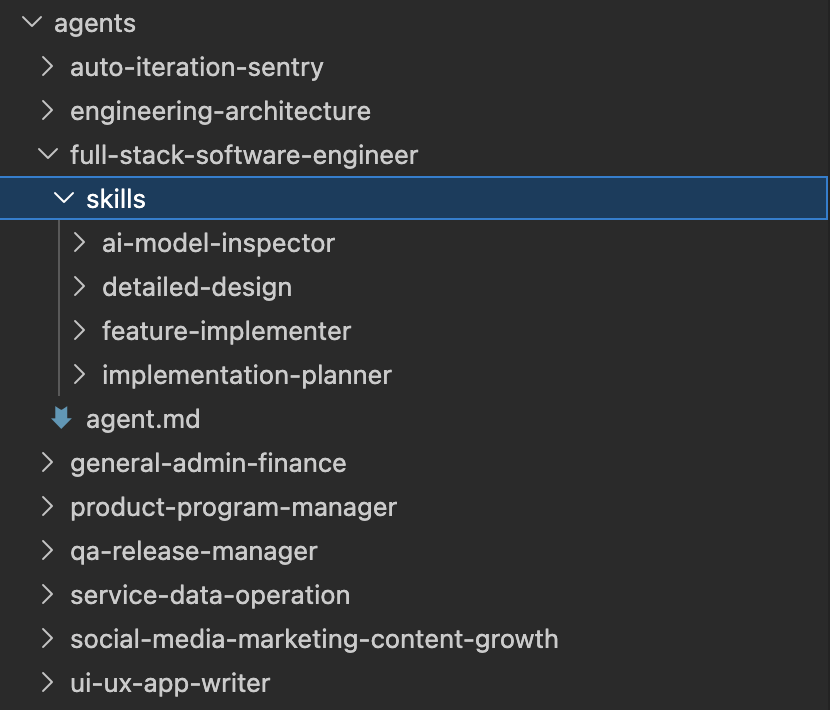
As shown above, agents/ is organized by role (Product Manager, Architect, Full-Stack Engineer, QA Release Manager, UI/UX, Operations, etc.), with each Agent directory aggregating its required skills/, tools/, and agent.md contract file.
3.2 Skills Example: Reusable Capability Catalog
Skills are the smallest deployable capability units callable by Agents, organized by lifecycle:
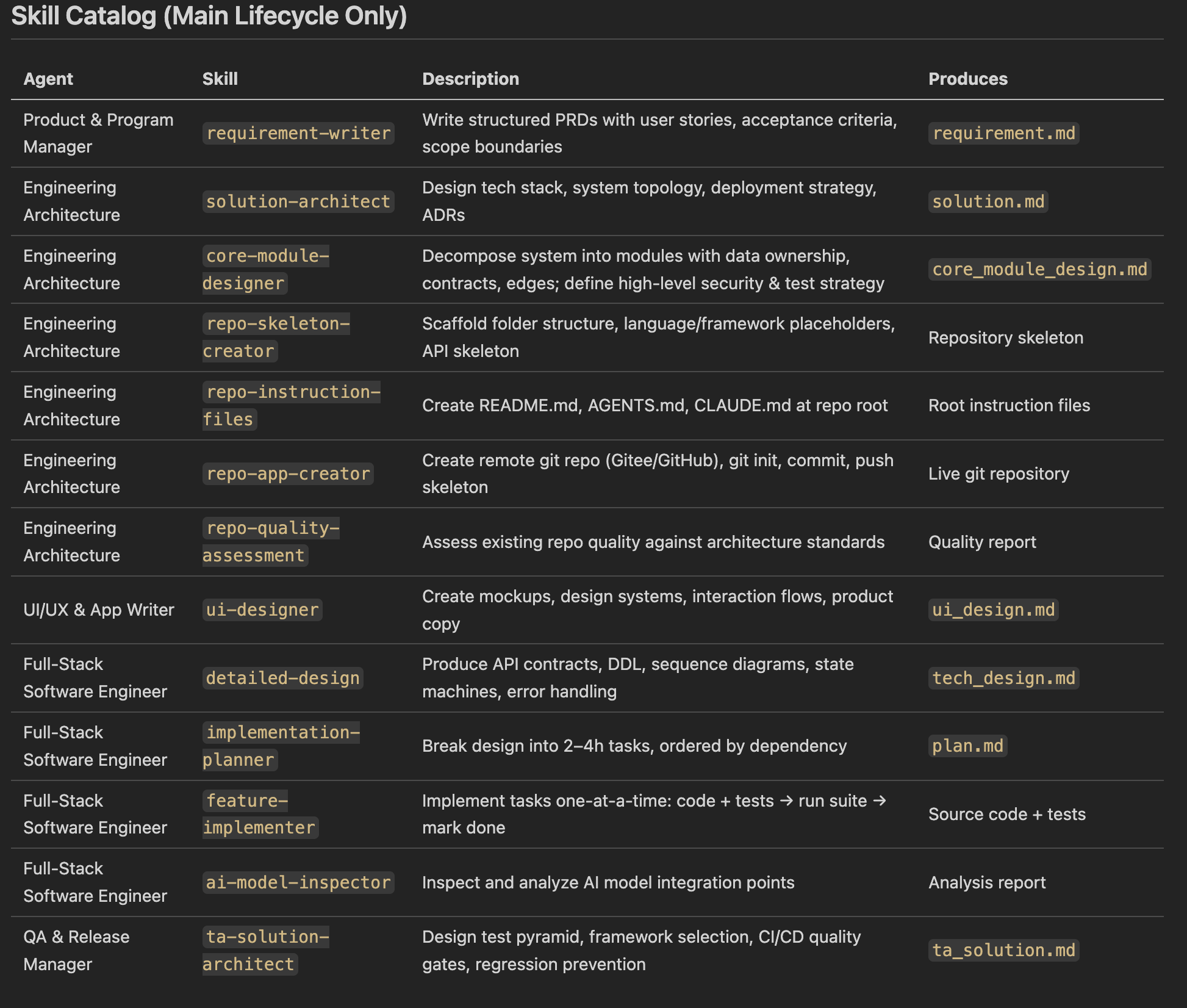
Each Skill explicitly specifies: which Agent it belongs to, what the input is, and what artifact it produces — ensuring predictable, auditable AI output.
Capability 4: Long-Term Iteration — Every Rework, Every Problem Is an Opportunity for Rule Optimization
Whenever AI output doesn’t match expectations, immediately conduct a root cause post-mortem and write the preventive rule into AGENTS.md or the corresponding Skill. Continuously iterate and optimize AI behavior. This sustainably reduces communication cost and rework effort while trimming unnecessary context and conserving Token overhead.
Core insight: When a Skill produces incorrect output in certain scenarios, the answer is not “switch models” or “switch Agents.” The answer is to re-examine the gaps in the rule itself.
Implementation tool: JinJinXia — an AI Coding Agent conversation capture and analysis platform, built explicitly to serve the goal of “improving AI Skill capability.” It captures AI conversations through Claude Code / Copilot hook mechanisms, uploads them to a server for intelligent analysis, and helps you trace exactly why each AI output deviated from expectations — whether the root cause was an incomplete requirement description or a gap in the rule itself. This enables targeted optimization of AGENTS.md and Skills — transforming “every rework is a rule optimization opportunity” from manual post-mortem into a sustainable, data-driven closed loop.
Capability 5: Workflow — Process-Driven Consistency
Workflow is the codification of the project’s overall development process (code → self-test → fix → commit → review → release). Encode high-frequency, repeatable workflows as reusable Skill sequences, enabling AI to proceed along established processes instead of improvising from scratch each time.
5.1 Engineering Lifecycle Workflow
From requirements to release — the complete engineering lifecycle, with each stage owned by a specific Agent:
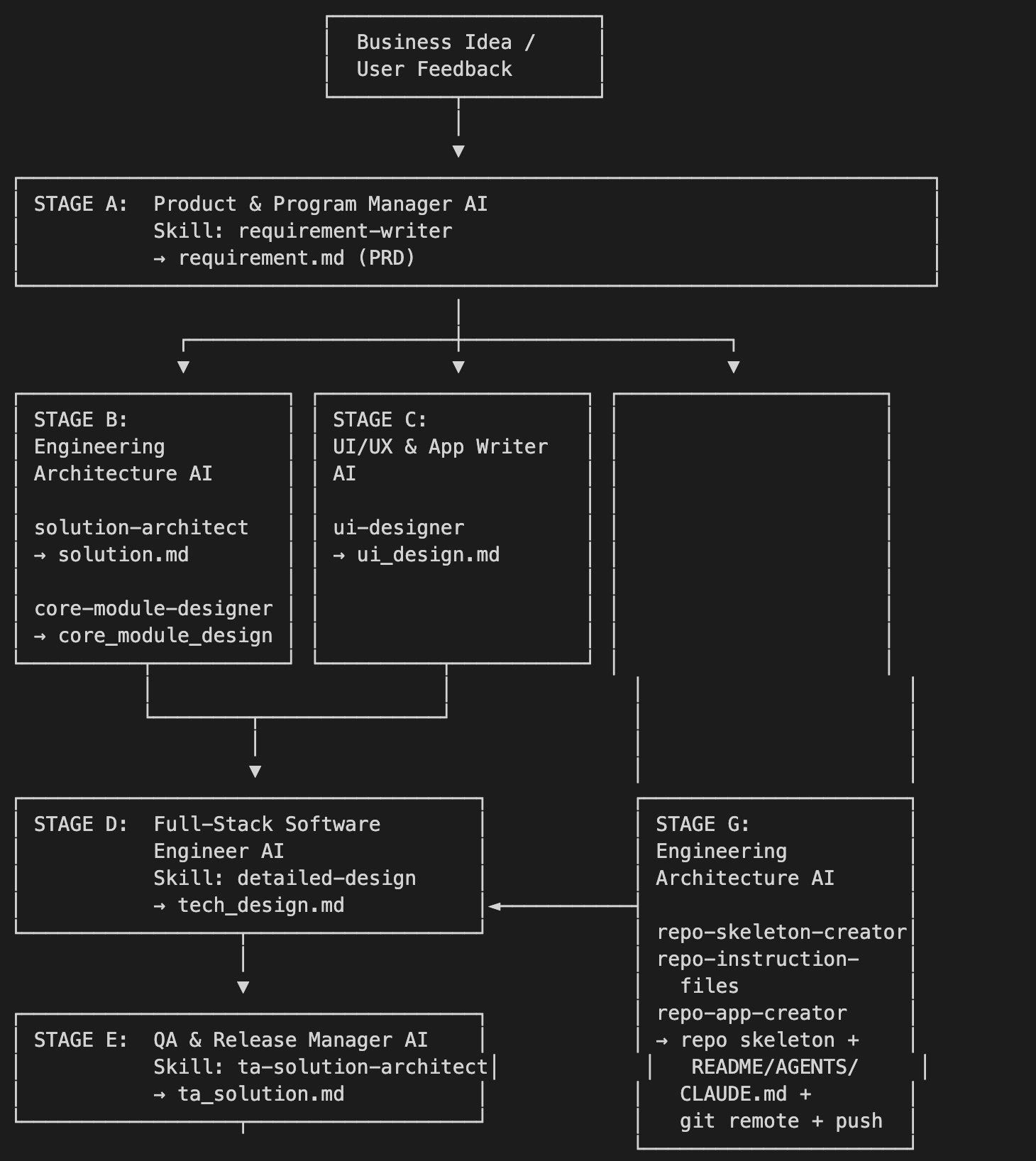
- STAGE A: Product Manager AI produces the PRD
- STAGE B/C: Architect AI and UI/UX AI produce their respective designs in parallel
- STAGE D: Full-Stack Engineer AI produces the detailed technical design
- STAGE E: QA Release Manager AI produces the test plan
- STAGE G: Architect AI handles repository scaffolding and instruction file initialization
5.2 Document Generation & Publishing Workflow
Document generation reads a unified configuration (config.yaml) first, then selects the appropriate publishing channel based on the scenario:
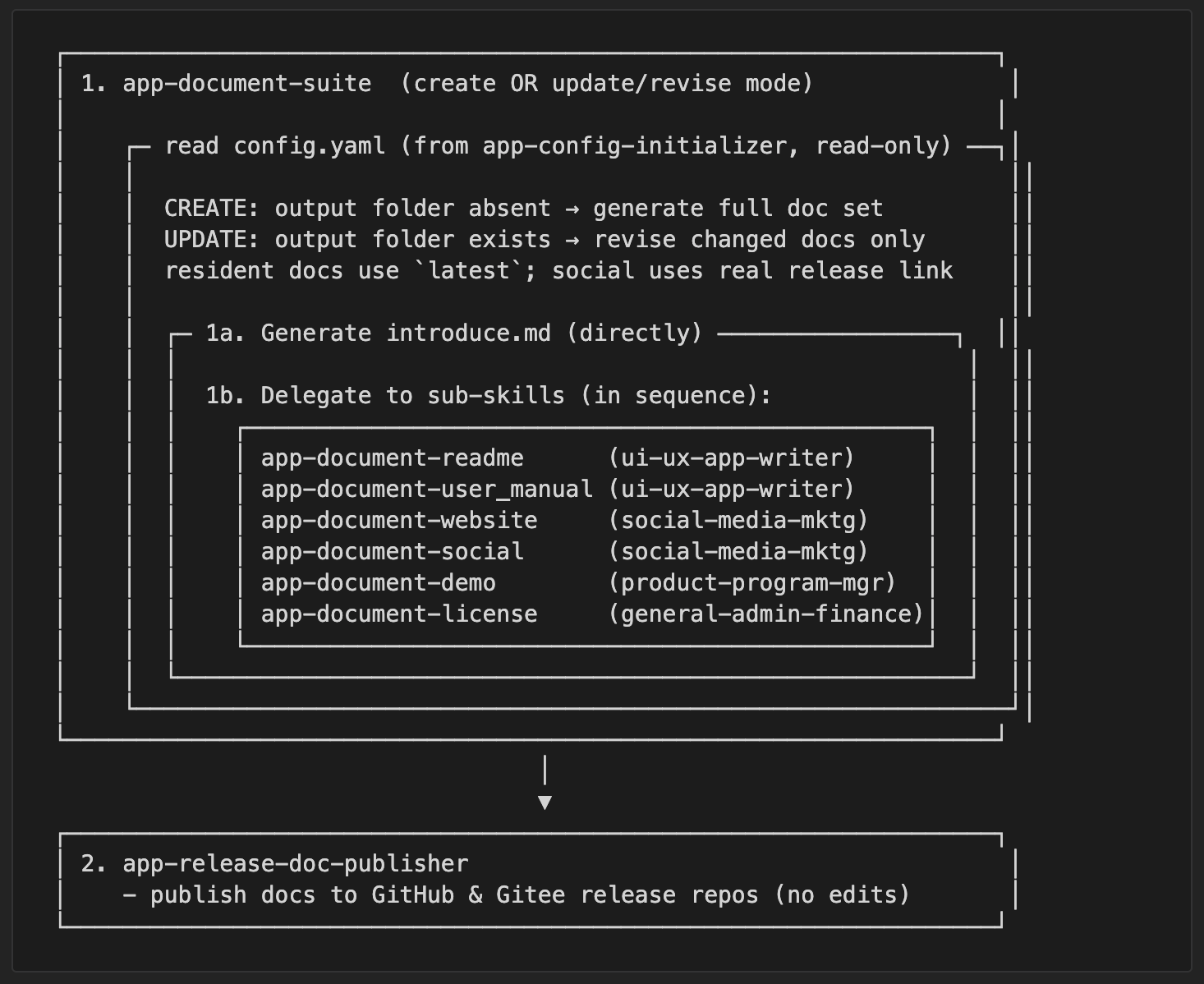
- create mode: First-time generation of the complete document set
- update mode: On-demand revision of changed documents
- Resident docs use
latest; social docs use real release links
5.3 App Release & Mirror Workflow
End-to-end flow from configuration initialization to dual-platform (GitHub/Gitee) release:
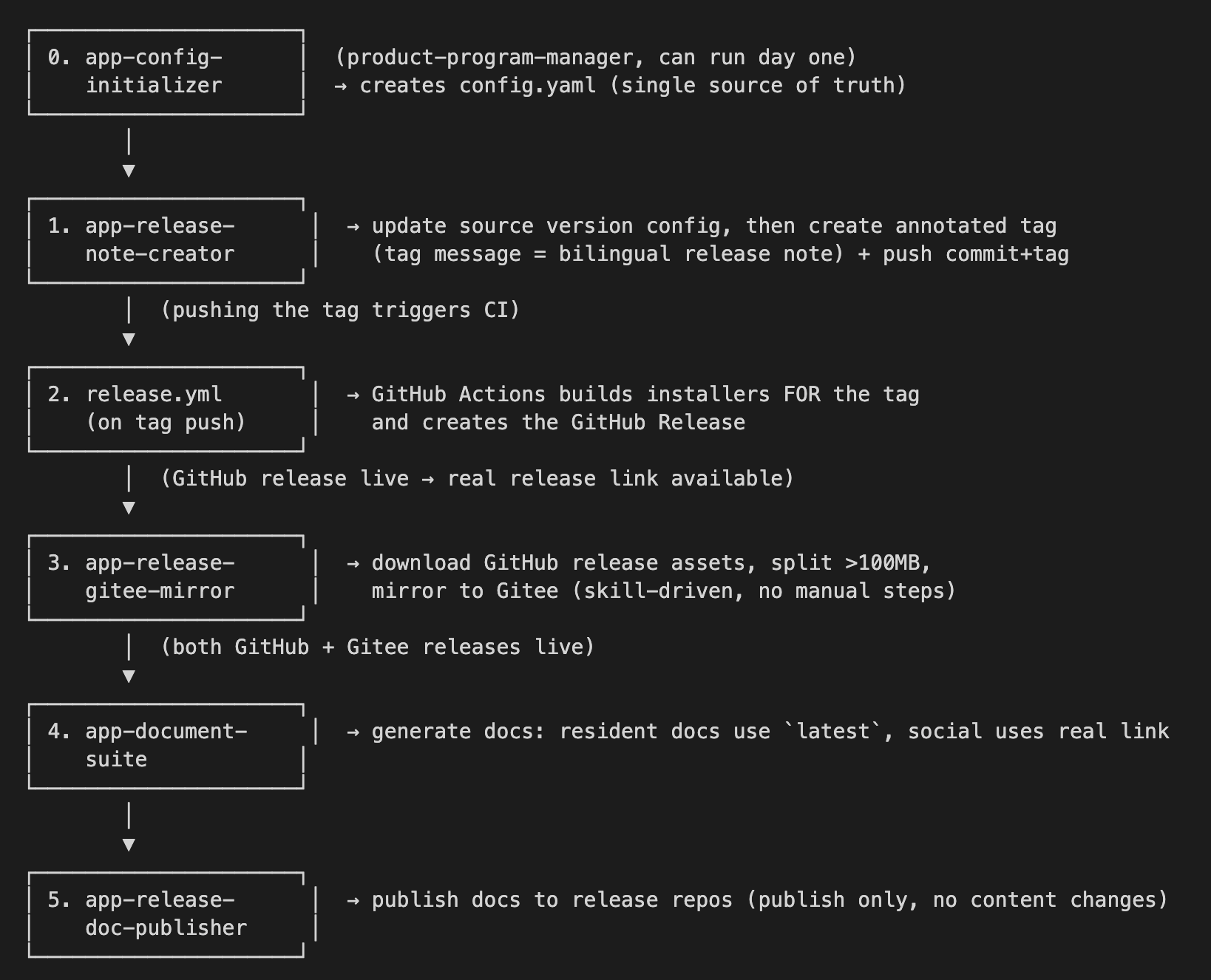
- Step 0:
app-config-initializergenerates the single source of truthconfig.yaml - Step 1: Tag triggers CI, which auto-generates bilingual release notes
- Step 2: GitHub Actions builds the installer packages and creates the Release
- Step 3: Automatic mirroring to Gitee (handling assets >100MB)
- Steps 4–5: Documentation generation and publishing to the release repository
Value: Through Workflow, implicit human expertise is codified into reusable, auditable, and optimizable standard processes — ensuring output consistency while enabling AI to reliably handle high-frequency, repeatable work.
Capability 6: Establish a Quantitative Evaluation System — Measure AI’s Real Value with Data
Core observation metric: AI Code Rework Rate (the proportion of AI-generated code that requires rework before being production-ready).
Supporting observation dimensions:
- Direct Acceptance Rate: Proportion of AI-generated code merged into the repository without modification
- Human Correction Magnitude: Three-tier classification — minor tweaks, major rewrites, complete discard
- Long-Term Degradation Indicators: Defect rate at 30 and 90 days post-merge, production incident rate for AI-authored code
- Cost Metrics: Token consumption per unit of effective code — measures the cost-reduction benefit from prompt optimization and
AGENTS.mditeration
A higher rework rate signals gaps in the instruction system and project AI specifications, requiring reverse optimization of the Prompt system and Agent rules — forming the closed loop: Use → Evaluate → Optimize Rules → Improve Quality & Reduce Cost.
4. Conclusion: The Engineer’s Core Positioning in the AI Era
AI handles the execution layer — repetitive coding, information retrieval, basic solution generation. The engineer firmly controls requirements definition, rule formulation, architecture design, quality verification, cost governance, and risk management.
Outstanding engineers are not being replaced by AI. They are building specification systems that harness AI as a disciplined tool — improving efficiency while controlling cost and technical debt. Average users will be swept along by AI’s output, bearing high costs and endless rework.
Future Engineer’s Core Competence = Domain Expertise + AI Orchestration Capability + Engineering Rule Accumulation + AI Cost Governance Awareness
Further Reading:
If you’re practicing AI engineering discipline on your team, or have hit interesting failure modes worth codifying into rules, I’d love to hear about it in the comments.