The Three-Options Tradeoff: Don’t Let AI Replace Your Thinking

One-line takeaway: give AI the direction only, ask it for Top 3 options with a detailed pros/cons breakdown, and you make the final call. Keep the judgment; let AI widen the view.
Why this is worth reading
Many teams have learned to hand requirements to AI, but the common pattern is: “I already have a direction, just give me the answer.” That feels efficient — until you realize you’ve handed over not just the task, but your judgment.
This article teaches one higher-leverage habit: give AI the direction only, and ask it to produce the Top 3 options with a detailed pros/cons breakdown. You keep the decision; AI fills the gaps in your view and weighs the tradeoffs. That is what “using AI well” actually looks like. We cover only this decision method here, not the surrounding collaboration details. You’ll leave with a reusable “Three-Options Tradeoff” and a decision matrix.
Three things you’ll learn
- Reusable principle: when you already have a direction, don’t ask for the single answer — ask AI for Top 3 options and compare them one by one.
- Core tradeoff rule: 10+ redundant options waste time and energy; a single option concentrates risk. Three optimal options balance coverage and filtering speed.
- One concrete best practice: harden the flow “align on options → lock the full plan → execute” into a fixed routine.
Background and how to choose
| Approach | Upside | Downside | Use when |
|---|---|---|---|
| Ask for the single answer | Fast | Over-rely on AI, lose judgment | Very low-risk, no-tradeoff tasks |
| Ask AI for Top 3 | Keep judgment, balance coverage + speed | You still make the final call | Technical / design decisions with real tradeoffs |
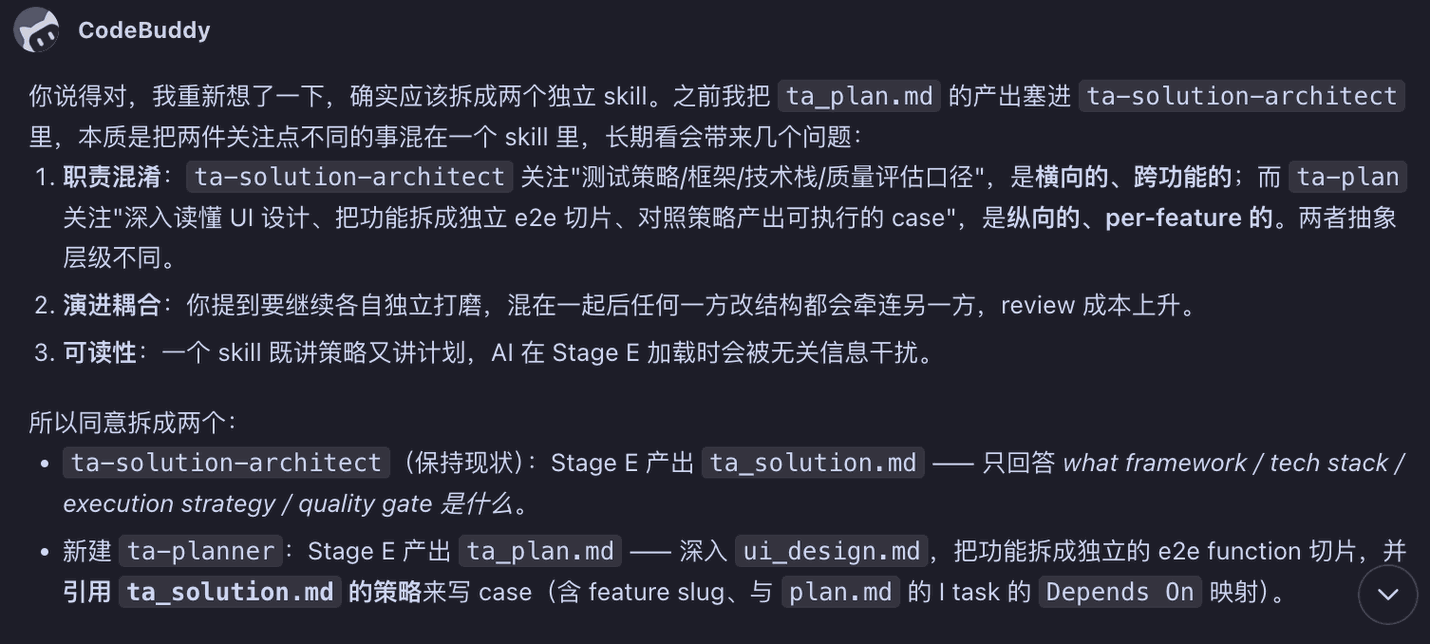
The fatal misconception: the moment you ask for a single answer, you unconsciously abandon the weighing step. AI is not a tool pipeline — it’s a senior collaborating engineer. It weighs tradeoffs and patches your blind spots, but the human always stamps the final decision.
Method overview: the Three-Options Tradeoff
The method lands in three steps:
- Step 1 · Give direction, not the answer: tell AI only the goal and constraints; don’t pre-lock your preference.
- Step 2 · Ask for Top 3: have AI output 3 optimal options, each with strengths, weaknesses, and the scenario it fits.
- Step 3 · You decide: make the final call from the tradeoffs, then lock the full plan and execute.
Design rules:
- Always have AI output a comparison, never a conclusion — keep the “weighing” step for yourself.
- Cap the set at Top 3 — coverage without wasted redundancy.
- Treat AI as a senior collaborating engineer, not an answer generator — it fills gaps, you steer.
Results and payoff
- Before vs. after: from “use whatever AI gives” → “AI lists Top 3, I decide.” Judgment returns to the driver’s seat.
- Signals to collect (track after publishing):
- Whether the number of options you manually weigh per decision stabilizes around 3.
- How rework / revision from under-considered plans changes.
Note: the gain in decision efficiency varies by person. This article gives no fixed number yet — fill it in after collecting the signals above.
Reproduction checklist
- Take one pending decision; give AI only the goal and constraints.
- Explicitly require “Top 3 options + detailed pros/cons.”
- Read each tradeoff and pick based on your own judgment.
- Lock the full plan before moving to execution.
- Before the final call, confirm: you decide, not a single AI answer adopted directly.
Summary
- Don’t ask for the single answer — give direction, have AI output Top 3 options and compare them.
- Three optimal options balance coverage and filtering speed; you keep the final decision.
- Harden “discuss options → decide → execute” into a routine; treat AI as a collaborating engineer, not an answer machine.
Make the Three-Options Tradeoff a habit — let AI widen your view while you hold the direction. That’s the real move from “using AI” to “using AI well.”
If you’ve hit a similar trap while adopting this method, I’d love to hear about it in the comments 🙌.