Pre-refine Your Prompt: Cut AI Errors at Near-Zero Cost
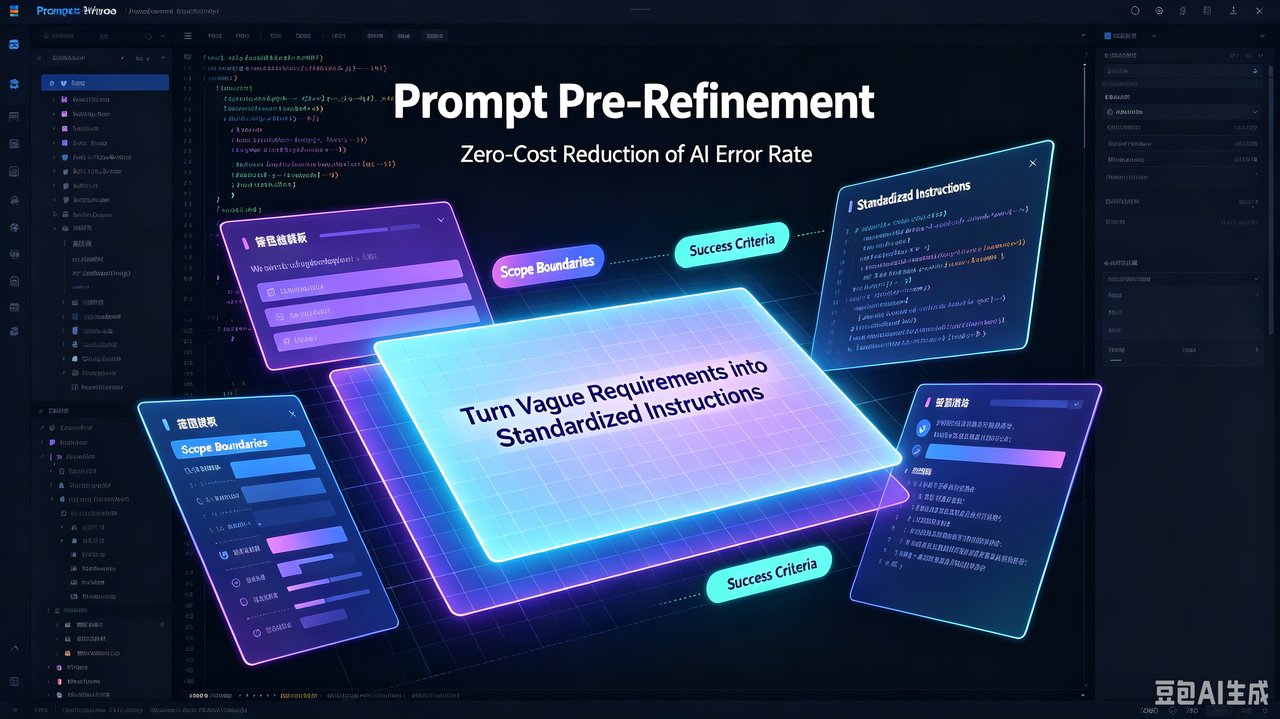
Handing a raw requirement straight to AI often costs more than you think — not just in rework, but in repeatedly burning the compute of an expensive model. This post does one thing: before any serious task runs, use a chat model to polish the rough idea in your head into a structured instruction, then hand that to the execution model.
One-line takeaway: spend one or two minutes on pre-refinement and you save multiplied rework and compute. Never hand a costly task a raw, vague idea.
Why this is worth reading
Handing a raw requirement straight to AI is basically handing it the ambiguity too. The model guesses your real intent from the literal text; wherever it guesses wrong is where rework starts. And for an expensive model, one rerun is one pure waste of compute — visible and avoidable.
The real pain shows up in high-cost scenarios: large refactors, batch engineering jobs. One ambiguous phrase and the execution model runs down the wrong path until you notice — by then compute and time are already spent.
Four things you’ll take away
- A reusable principle: before any costly task, have a model refine your raw prompt to kill ambiguity and pin down boundaries.
- The core trade-off: shipping a raw idea = you eat the risk; refining into a standard instruction = you prevent drift and duplicate labor at the source.
- One concrete best practice: make “never ship a raw vague idea” a habit, and drive AI with the refined standard instruction.
- Refine once, reuse forever: distill the validated high-quality prompt into a Skill / Workflow / Agent so AI follows the spec automatically next time.
Background and the choice
| Approach | Pros | Cons | Best for |
|---|---|---|---|
| Ship the raw idea | Fast, zero friction | Vague need → AI drifts → expensive reruns | Very low-risk micro tasks |
| Refine then ship | Kills ambiguity, clear bounds | Costs one or two minutes | Big tasks, batch work, Agent automation |
The root cause is a causal chain: vague requirement → AI misinterprets → expensive model reruns = wasted compute. Pre-refinement puts a gate at the very front of that chain. Near-zero cost, but a clear drop in rework rate.
Overview: a three-step pre-refinement workflow
The point is to separate “what to think” from “what to do”:
- Step 1 · Dump the raw idea: give the chat model your fuzzy need as-is, unfiltered, uncut.
- Step 2 · Let it refine: have the model fill gaps, split tasks, remove ambiguity, and clarify boundaries.
- Step 3 · Execute from the standard instruction: use the refined result as the formal instruction for the execution model / Agent.
The standard template for refining a raw prompt into a structured instruction (copy and reuse):
【Task】<one sentence on what to do>
【Scope】<what is explicitly in / out of scope>
【Success Criteria】<what "done" looks like>
【Output Requirements】<format, length, deliverables>
【Constraints】<hard limits: resources, performance, compliance>
Three iron rules:
- Always refine first, then execute — never hand a costly task a raw vague idea.
- The instruction must state both “Scope” and “Success Criteria”; neither is optional.
- Treat the refinement template as a reusable asset — next time, edit the fields, don’t rewrite from scratch.
This workflow fits high-cost scenarios: large refactors, batch engineering, Agent automation, complex copywriting. The higher the cost, the higher the payoff of this one step.
Advanced: distill high-quality prompts into Skill / Workflow / Agent
The end of refinement isn’t “manually refine every time” — it’s distilling the validated high-quality prompt into a Skill / Workflow / Agent so that next time the same task arrives, AI follows the spec automatically, skipping even the manual refinement.
- Into a Skill: package the validated instruction as a Skill with a clear trigger description (when to use it) + inline execution rules + a self-check list. AI recognizes and applies it for similar tasks.
- Into a Workflow: write the fixed flow as a standard workflow / script; AI only schedules and fills parameters, it doesn’t re-reason the steps on the fly.
- Into an Agent: turn the refined standard instruction into a dedicated Agent / sub-agent; similar tasks are dispatched to it and the main flow only consumes the conclusion.
One test only: the second time the same high-quality prompt is reused, it should be distilled. First time is extraction; second time it should become AI’s default behavior. One Skill / Agent holds one class of task spec — don’t cram unrelated tasks into the same one, or triggers collide and you’re back to vague instructions.
Advanced tip: let DouBao revise your request
The template is one form of refinement; there’s an even easier best practice: hand your request to DouBao and let it revise once — especially when the request is fairly complex.
The value isn’t the revision itself, it’s the comparison: if the revised version diverges from your original, that divergence is a diagnostic signal — your original was ambiguous, or under-specified.
- Wording changed, meaning shifted → the original was ambiguous; the model read a different intent.
- Missing premises or conditions filled in → under-specified; the model made default assumptions for you.
- Structure reordered → your logic was unclear; the model was straightening it out.
Treat “let AI rewrite my request” as a mirror: every change it makes is a projection of a problem in your original. Use a free / cheap chat model for this step so the refinement itself costs nothing.
Results and payoff
Going from “dump raw idea to the expensive model” to “refine into a standard instruction first” costs about 1–2 minutes of human time. The real rework-rate drop depends on task complexity and team habits, so this post gives no fixed number yet — after publishing, track two signals: how much the rework / rerun rate drops on costly tasks, and the compute + time saved per task.
Reproduction checklist
- Pick a costly task and dump the raw idea to a chat model as-is.
- Have it refine: fill gaps, split tasks, remove ambiguity.
- Organize into the standard template above, stating Scope and Success Criteria.
- For complex requests, let DouBao revise once and fold every divergence back into the original.
- Execute from the refined instruction and record rework / reruns as a baseline.
- The second time the same high-quality prompt is reused, distill it into a Skill / Workflow / Agent.
Summary
- Before costly tasks, use a chat model to refine the raw idea into a standard instruction, killing ambiguity at the source.
- Always state both “Scope” and “Success Criteria” in the instruction — neither is optional.
- Treat the refinement template as a reusable asset — one extra minute saves multiplied rework and compute.
- The end of refinement is distillation: fold the validated prompt into a Skill / Workflow / Agent so AI follows the spec automatically.
Bake pre-refinement into your workflow, then turn it into AI’s default behavior via Skill / Workflow / Agent — one minimal step for steadier output and lower hidden cost.