AI Cost-Effective Series — Cross-Platform Pricing: Why Unit-Price Division Misses the Real Gap
One-line conclusion: cross-platform price comparison fails because billing units don’t match — IDEs charge in credits, the DeepSeek official API charges in tokens, and there is no official conversion. Comparing relative multipliers within the same unit, then measuring actual charges on a real task, is the trustworthy way to find the real cost gap.
Why this matters
Many people pick an AI tool by “which model is strongest” and miss a painful fact: the same job can cost very differently across IDEs. Often it’s the platform premium — not the model — driving the bill.
But quantifying that gap is harder than the marketing suggests. The core blocker is billing units not matching: CodeBuddy / Qoder / TRAE bill in credits, the DeepSeek official API bills in tokens, and no official conversion exists between one credit and a token/request count. Dividing two incompatible numbers yields a number that looks precise but isn’t.
This post is in the AI Cost-Effective Series (Cognition & Selection track). It focuses purely on price-comparison logic — how the four pricing strategies differ and how to compare them honestly. Model-tiering strategy is a separate topic covered elsewhere in the series.
What you’ll learn
- The real obstacle to cross-platform price comparison is inconsistent billing units (credits/tokens mixed, no official credit↔token conversion), so unit-price division is unreliable.
- The four typical pricing strategies: budget tiering (CodeBuddy), off-peak discount (Qoder), tiered pricing (TRAE), and per-token billing (DeepSeek official API).
- The dependable method: run the same real task on multiple platforms and compare what each actually charges — switching cost is ≈ 0, so it’s worth trying.
Background and the selection mindset
First, clarify a common confusion: DeepSeek has two identities. It’s an open-source model that CodeBuddy / Qoder / TRAE can integrate or deploy (charged in each IDE’s credit system), and it’s a provider of an official API billed directly per token, outside any credit system. In this post, “DeepSeek” refers to the official API when used as a standalone row; inside an IDE row it refers to the integrated DeepSeek model billed at that IDE’s credit multiplier.
Cross-platform comparison isn’t “pick whichever is cheaper.” It depends on what hours you use AI and which platform hosts your primary models. Comparing the pricing strategies side by side is how you find the one that fits your habits.
Evaluation dimensions: pricing-strategy type, key tier cost, dominant-hours fit, and primary-model ecosystem.
| Platform | Type | Pricing strategy | Key tier | Billing unit | Best for |
|---|---|---|---|---|---|
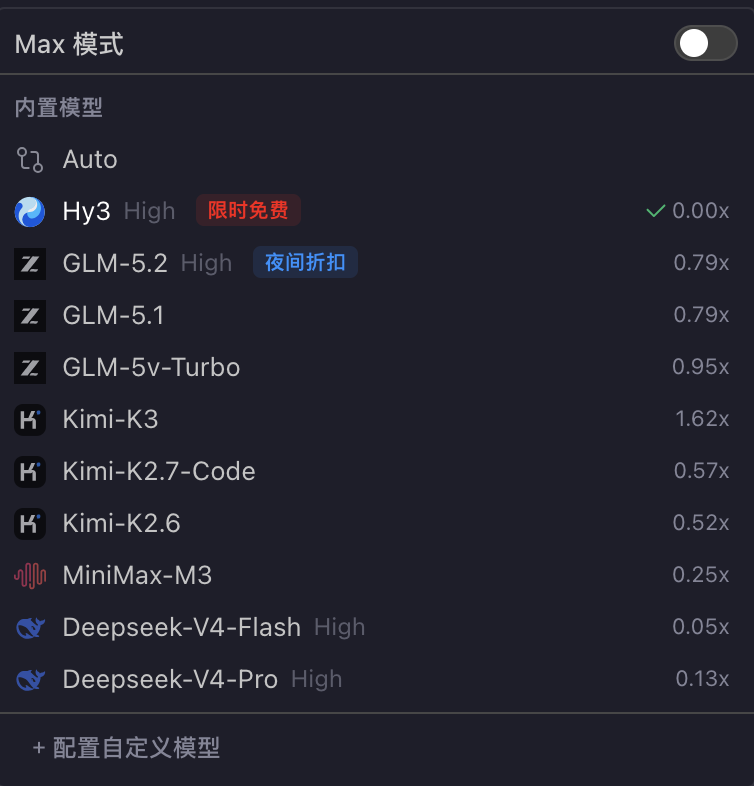
| CodeBuddy | IDE | Budget tiering + cheap Flash | Hy3 base tier + DS-V4-Flash 0.05x | credits (× multiplier) | Daytime, DeepSeek-centric |
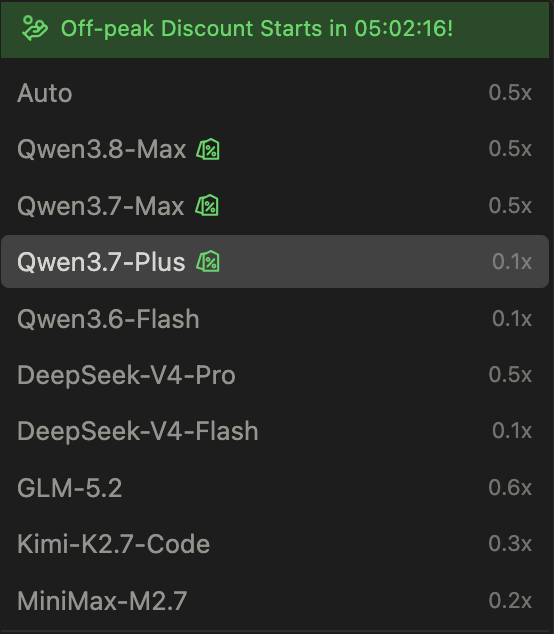
| Qoder | IDE | Off-peak discount | Qwen3.7-Plus only 0.1x | credits (× multiplier) | Night work, Qwen-centric |
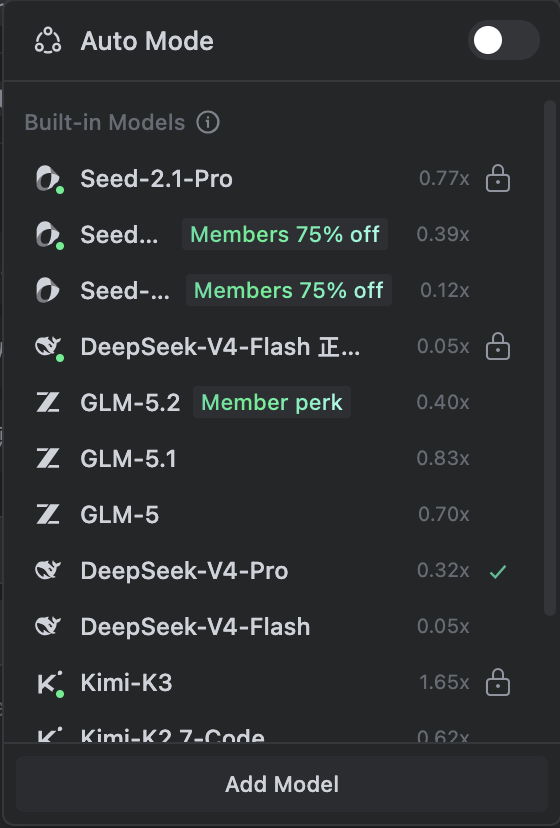
| TRAE | IDE | Seed-Pro + DeepSeek tiering | Seed-2.1-Pro 0.77x + DeepSeek series tiers | credits (× multiplier) | Seed quality + DeepSeek-tier savings |
| DeepSeek | Model provider | Pure pay-as-you-go | DS-V4-Flash / DS-V4-Pro etc. | tokens (not credits) | Skip the IDE credit wrapper, pay per token |
Note: the “0.05x / 0.1x / 0.77x” values are multipliers applied to each vendor’s credit price — they are not absolute prices. And “1 credit” itself is not publicly aligned across platforms to any token/request amount. Most importantly: the first three bill in credits while DeepSeek bills in tokens — no official conversion — so dividing across units yields only a rough reference, not a conclusion.
Decision rule: decide your dominant hours first, your primary model second, then map to the right pricing shape. Don’t be misled by “gap N×” headlines — trustworthy cost is measured by running the same real task.
Solution overview: the four pricing forms
Price comparison isn’t theoretical — it’s what you see daily in the IDE’s settings. When you pick “which model,” that model’s multiplier differs per platform and directly determines your charge. So “choosing a model” and “reading subscription price” can’t be separated: model choice affects price, and price constrains which models you can reasonably use.
Subscription / billing details
- CodeBuddy: standard subscription, 2,000 base credits + 2,000 bonus credits per month (4,000 total), all models selectable, unlimited real-time code completion, 15 automation tasks (99 free), up to 10 projects, 5 collaborators per project. ¥99/mo, or ¥70/mo on a continuous subscription — about ¥348 saved per year. The “base + bonus” dual-track design is its pricing signature.

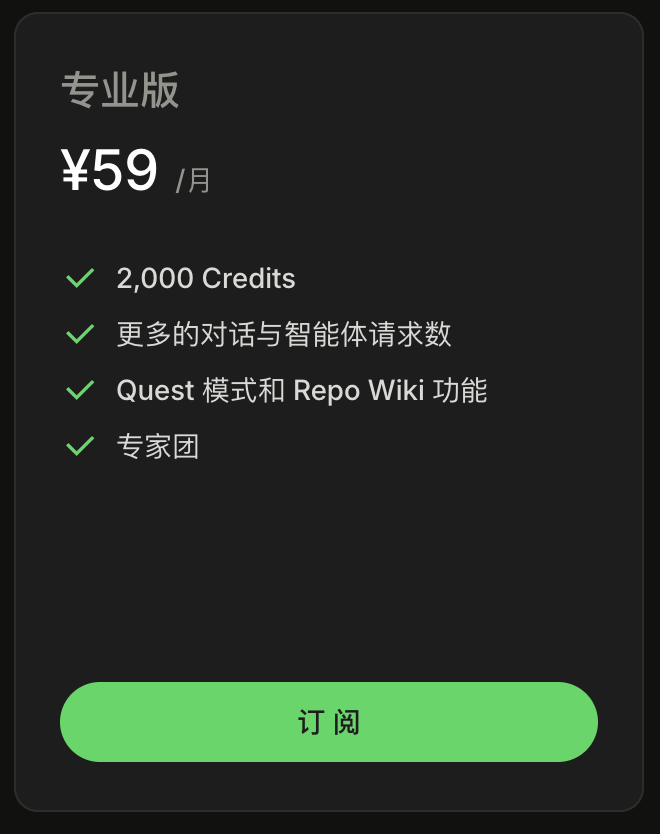
- Qoder: Pro subscription, ¥59/mo, 2,000 Credits/month + more conversation and agent requests, including Quest mode, Repo Wiki, expert panel. A single pricing tier + an Off-peak Discount model-rate combo.
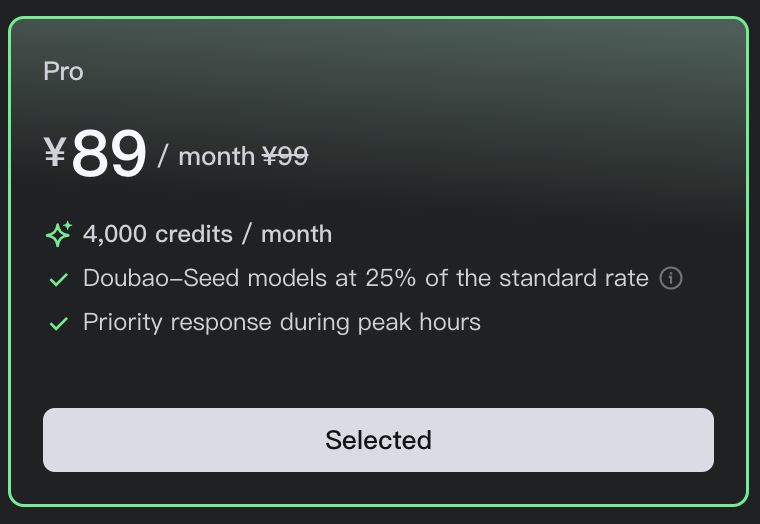
- TRAE: Pro subscription, ¥99/mo original, ¥89/mo promo, 4,000 credits/month. Includes Doubao-Seed models at 25% of standard rate and priority response during peak hours. “Subscription discount + model member pricing” is its double benefit.
- DeepSeek (model provider): as opposed to the three IDEs, this is the DeepSeek official API, billed directly per token, no credits. Outside the IDE’s credit wrapper, you get the raw per-token price. Remember: DeepSeek is also open source and can be integrated/deployed inside CodeBuddy / Qoder / TRAE — in that case it’s billed at that IDE’s credit multiplier.
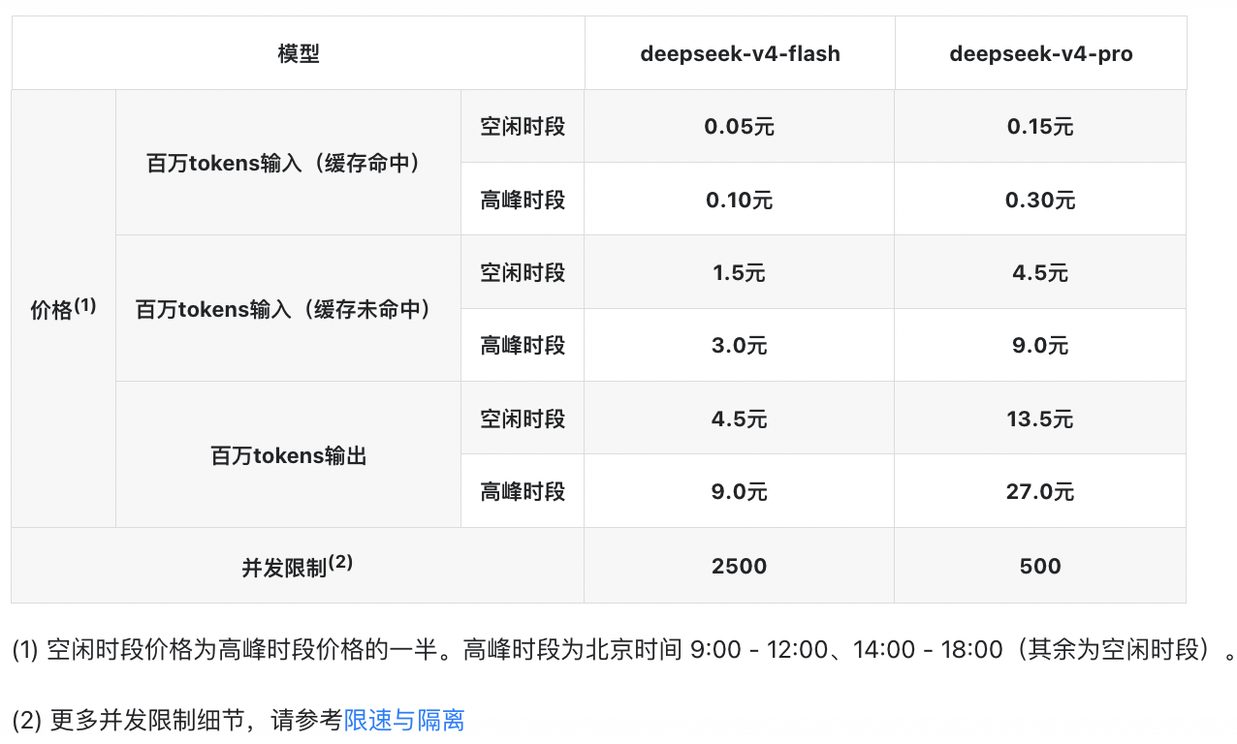
This is the cleanest illustration of “units don’t align”: three platforms charge credits, the DeepSeek official API charges tokens, with no official conversion — so you can never divide “0.05x credits” by “price per thousand tokens” and get a trustworthy gap.
Relative-multiplier comparison, benchmarked on DeepSeek-Flash
Unit misalignment doesn’t mean zero comparison is possible. Within one IDE, every model carries a multiplier relative to that IDE’s DeepSeek-Flash. So the same model across IDEs can be compared as a relative multiple — a same-calibre horizontal reference, still carrying credit/token conversion uncertainty, but usable:
Relative multiplier = a model’s rate in that IDE ÷ DeepSeek-Flash’s rate in that same IDE
For models appearing in at least two of the three IDEs, benchmarked on each IDE’s own DeepSeek-Flash:
| Model | CodeBuddy rate | CodeBuddy vs Flash | Qoder rate | Qoder vs Flash | TRAE rate | TRAE vs Flash |
|---|---|---|---|---|---|---|
| DeepSeek-V4-Flash (baseline) | 0.05x | 1x | 0.1x | 1x | 0.05x | 1x |
| DeepSeek-V4-Pro | 0.13x | 2.6x | 0.5x | 5x | 0.32x | 6.4x |
| GLM-5.2 | 0.79x | 15.8x | 0.6x | 6x | 0.40x | 8x |
| GLM-5.1 | 0.79x | 15.8x | — | — | 0.83x | 16.6x |
| Kimi-K2.7-Code | 0.57x | 11.4x | 0.3x | 3x | 0.62x | 12.4x |
| Kimi-K3 | 1.62x | 32.4x | — | — | 1.65x | 33x |
How to read it: benchmarked on each IDE’s DeepSeek-Flash, the same model costs a different relative multiple per IDE. GLM-5.2, for example, is ~15.8× Flash on CodeBuddy but only 6× on Qoder and 8× on TRAE. That’s far clearer than raw “0.79x vs 0.6x vs 0.4x” rates — switching IDEs isn’t just a different UI, it changes the same model’s relative cost structure.
Caveat: this relative multiple is not an absolute price gap — it rests on each vendor’s DeepSeek-Flash credit multiplier, and credit↔token conversion is still unknown. Its value is seeing the relative cost-per-model structure across IDEs; absolute values still need the hands-on task method below.
This table still gives you two practical things:
- Model selection within one IDE becomes informed — you can see at a glance how much more a model costs than that platform’s DeepSeek-Flash (e.g. GLM-5.2 is 15.8× Flash on CodeBuddy but only 6× on Qoder).
- Multi-IDE users know where to park each model — pick the IDE where a model is relatively cheapest (GLM-5.2 at 6× and Kimi-K2.7-Code at 3× both look cheapest on Qoder; Kimi-K3 is ~32–33× on both and basically indifferent).
For “what’s the absolute difference,” don’t trust headline multiples — verify with the hands-on task method (below).
Impact: an honest comparison method
The real payoff isn’t “one gap number,” it’s a comparison method that stays trustworthy under unit chaos:
- See the unit trap first: the same model is billed in tokens on one platform and credits on another, and “1 credit = how many tokens/requests” isn’t disclosed. Dividing multipliers yields rough reference, not conclusion.
- Replace unit-price division with a hands-on task method: pick a weekly high-frequency task (a code review, a refactor), run it on CodeBuddy / Qoder / TRAE / DeepSeek official API, and record how many credits/tokens each actually charged. That’s cost you can trust.
- The four pricing shapes are genuinely different: CodeBuddy’s budget tiering + Flash suits heavy daytime use; Qoder’s off-peak discount suits night owls; TRAE’s Seed-Pro + DeepSeek tiering suits people who want both Seed quality and tiered savings; the DeepSeek official API’s per-token billing suits anyone wanting to bypass the credit wrapper. Form differences are certain; number differences are rough.
Two verification paths:
- Manual ledger: log your main task’s actual charge on today’s IDE (credits or tokens — the real value), then re-run the same task on the other two platforms and compare actual charges instead of dividing unit-price multipliers.
- Automated usage self-analysis: the open-source
ai-usage-reportskill (github.com/KylinLabAI/kylinlab.tech.skills,skills/ai-usage-reportdirectory) scrapes CodeBuddy / Qoder / TRAE / DeepSeek web bills into a unified CSV and generates charts plus a cross-platform report. Say “use ai-usage-report to generate a 30-day usage analysis for qoder/codebuddy/trae/deepseek” and it runsscrape → verify → build → cross_platform_reportper platform.
One hard rule: fee columns mix units (Qoder/DeepSeek are ¥/quota, TRAE/CodeBuddy are credits), so cross-platform you can only compare dimensionless metrics — request counts, active days, top models. Never sum fees across platforms — it mirrors this article’s “units don’t align, don’t divide” conclusion.
Mistakes, tradeoffs, alternatives
- Don’t trust “N× cheaper” headlines. Marketing numbers nearly always compare unlike units or cherry-pick a niche tier. Treat them as a trigger to measure, not to switch.
- Don’t switch on price alone. Migration of configs/context is the one real friction left; verify it’s truly ~zero for your workflow before treating platform cost as the deciding factor.
- The relative-multiplier table can’t yield an absolute gap. It’s a same-calibre reference for structure, not a number to multiply into your budget. If someone gives you a firm absolute ratio, ask which unit conversion they used — there isn’t an official one.
- Why not just pick one cheap platform? Because your dominant hours and primary models determine which pricing shape is cheapest for you — the “cheapest IDE” differs between daytime DeepSeek-heavy work and night Qwen-heavy work.
Reproduction checklist
- Look up your primary model’s unit price and billing unit (credits or tokens) on your current IDE.
- Check it against this table’s pricing shapes on the other platforms (budget tiering / off-peak discount / tiered / per-token) — but don’t divide multipliers to compute a gap.
- Track your daytime/nighttime usage ratio to decide between budget tiering and off-peak discounts.
- Pick one high-frequency task, run it on target platforms, and record the actual charge rather than comparing unit-price bills.
- Or use
ai-usage-reportto auto-scrape bills (CSV + charts + cross-platform overview), comparing only request counts / active days / top models — never summing fees across units. - Confirm the actual cost of switching platforms (config/context migration) is truly ~0.
Summary
- Don’t just watch model names: the same model really costs differently across IDEs, but with inconsistent billing units (credits/tokens mixed, no official credit↔token conversion), dividing multipliers yields only rough reference.
- The four pricing shapes each have their strengths: CodeBuddy budget tiering + Flash, Qoder off-peak discount, TRAE Seed-Pro + DeepSeek tiering, and the per-token DeepSeek official API — map to them by dominant hours and primary model. Form differences are certain; number differences are rough.
- The trustworthy comparison is “run the same task on several platforms and read the actual charge” — and switching cost is ≈ 0, so it’s worth trying.
Don’t delete any IDE yet. Pick a weekly high-frequency task, run it once on each of the three IDEs and the DeepSeek official API, record the real charges — the winner becomes obvious, instead of guessing from unit-price multipliers.
Related posts in this series:
- AI Cost-Effective Series — Opening: Why You Should Rethink and Choose AI Smartly
- AI Cost-Effective Series — Model Tiering: 4 Tiers Cover 90% of Dev Tasks
Related tools:
- ai-usage-report open-source skill: https://github.com/KylinLabAI/kylinlab.tech.skills